Verse 21821uurthaa
G3
1
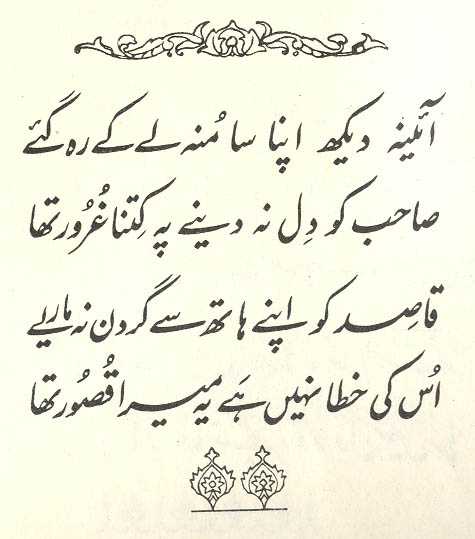
please don't wring the Messenger 's neck with your own hands!
2
it's not his error/mistake-- this was my fault/defect!
taa>> : 'A wrong action, fault; a mistake, an error; an unintentional fault or offence, a slip, an oversight; failure; miss (as of an arrow, &c.)'.
'A falling short (of), a failing (of or in); deficiency; decrease; defect; failure, want, default; omission; miss; shortcoming, error, faultiness, fault, sin; inaccuracy, incorrectness'.
| References | |
|---|---|
| Arshi, Imtiyaz Ali | Ghazal# 18 |
| Raza, Kalidas Gupta | 323 |
| Nuskhah-e-Hamidiyah | 63-64 |
| Asi, Abdul Bari | 65-66 |
| Gyan Chand | 98-100 |
| Hamid Ali Khan | Open Image |
That is, it's the limit of jealousy, that I can't stand it even if she kills someone-- I long for her to kill me. Through the words 'with your own hands' the author has gestured toward jealousy. (38)
== Nazm page 38

Urdu text: Vajid 1902 {40}
Passion does not permit the beloved to kill someone with her own hands, while the lover watches. Mirza Sahib has expressed this theme in this delicate garb. And in claiming the Messenger's fault as his own fault, the goal is that she would kill him with her own hands. (76)
'Please don't kill the Messenger with your own hands! This deed is beneath your dignity. In addition, a messenger is not to be punished. The sin is mine. And my head is at your service. What did that innocent one do? My life is not dear to me. Don't murder him and become ill-famed!' (92-93)
This is one of those verses that are truly funny-- not in a sophisticated, understated, ironic way, but almost as part of a slapstick routine.
The lover has sent a Messenger with a letter, and the beloved is so enraged at this insolence that she threatens to wring the offender's neck with her own hands. For anybody else, the neck-wringing would be the operative part of her threat, but of course for the lover it's 'with her own hands'. He can't stand the idea that somebody else-- and his own lowly Messenger, to boot-- should get such a treat.
So in the second line he protests, and the funniest part is that his rhetoric is exactly that of chivalry. He sounds like someone trying to save a friend from severe punishment by gallantly taking all the guilt on himself. There's nothing in the verse to tell us otherwise (except perhaps the second line's slightly overblown insistence and repetitiveness). But of course, since we know the lover, we know he's really using the rhetoric of a child trying to reclaim a toy from a sibling. In the guise of unselfish gallantry, he's selfishly clamoring for a treat. And what a treat-- the honor of having his neck wrung. It's so absurd, you have to laugh.
If we want to get into heavy-duty analysis, we can always consider the relationship between and . The former is based on the idea of 'to do wrong' (Platts p.490), while the latter is derived from : 'diminution; deficiency; defect, something wanting' (Platts p.791). Does the lover also want to emphasize that this wasn't a small, trivial mistake (one that won't happen again), but rather a genuine deficiency or defect (one in need of more serious correction)? In most verses, this kind of thing would be worth thinking about. But in this one-- do we really care?
graphics/myfault.jpg