Verse 11821uurthaa
G3
1
having looked in the mirror she remained 'at a loss'--
2
on not giving the heart, how much pride/vainglory the Her Lordship had!
'(orig.) A thing by which one is deceived'; pride, haughtiness, vanity, vainglory'.
| References | |
|---|---|
| Arshi, Imtiyaz Ali | Ghazal# 18 |
| Raza, Kalidas Gupta | 323 |
| Nuskhah-e-Hamidiyah | 63-64 |
| Asi, Abdul Bari | 65-66 |
| Gyan Chand | 98-100 |
| Hamid Ali Khan | Open Image |
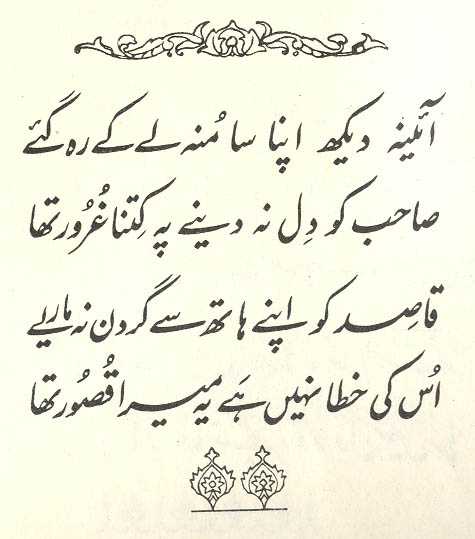
That is, pride accomplished nothing, she became infatuated with her own self. (38)
== Nazm page 38

Urdu text: Vajid 1902 {40}
Mirza Sahib says to the beloved, 'You taunted me for my passion, and mocked me. [Now] you've looked in the mirror and have yourself fallen in love with your own aspect. Now what has become of your pride at not giving your heart?' (75)
In this verse the subtlety is that outwardly it's not apparent that what the poet has in mind is to praise the uniqueness of the beloved's beauty; but in reality, it's exactly this. (92)
What a spectacular example of how to build a verse around an idiom! In the first line, the expression implies something like to be taken aback, to be abashed or humbled, to be at a loss. Vajid explains it as 'to be ashamed; to be embarrassed at one's question not being answered and to fall silent; to be anxious/disturbed'. The idiom seems to envision someone as becoming frozen, unable to react effectively.
Literally, though, it of course means something like 'to take a face like one's own and remain [that way]'. And what could be a better way to describe someone obsessively studying herself in a mirror?
The first line is, as so often, incomprehensible until the second line is provided. The second line at first looks somewhat tangential: it exclaims at what pride-- and here the root meaning of as 'something by which one is deceived' (see the definition above) also works perfectly-- the 'Sahib' had shown at not giving her heart. Only the power of implication enables us to realize that when she looked in the mirror she fell in love with her own peerless image, in a classically Narcissus-like way.
Thus the second line marvels (and also gloats) to see how the mighty are fallen. She is still the lordly 'Sahib' to the lover-- such a title can never be entirely ironic to him-- but she's no longer lord and master of her own emotions. For once, the lover will have his revenge-- which otherwise he scarcely dares to expect even on Judgment Day (see 25,8 ). For more verses about the beloved's falling in love, see 13,2 .
The second line could also of course be read as 'on not giving her heart to the Sahib, how much pride/vainglory she had!'. The main reason this reading should be discounted is that in relation to the beloved the lover would never call himself something as pretentiously masterful as a 'Sahib'; there's also no reason the beloved would be especially proud of not giving her heart to this lover (the 'Sahib') in particular. On the contrary: she's proud of her lordly behavior in not giving her heart to anyone-- which is why she's so flabbergasted to realize that she's given it to herself.
graphics/sadbelovedmet.jpg
graphics/mirror.jpg