Verse 11816amhai
G9
In this meter the next-to-last long syllable may be replaced by two shorts.
1
don't ask about the prescription for salve/ointment for wounds of the heart
2
for in it a fragment of diamond is the chief part
| References | |
|---|---|
| Arshi, Imtiyaz Ali | Ghazal# 195 |
| Raza, Kalidas Gupta | 281 |
| Nuskhah-e-Hamidiyah | 231 |
| Asi, Abdul Bari | 295-296 |
| Gyan Chand | 434-435 |
| Hamid Ali Khan | Open Image |
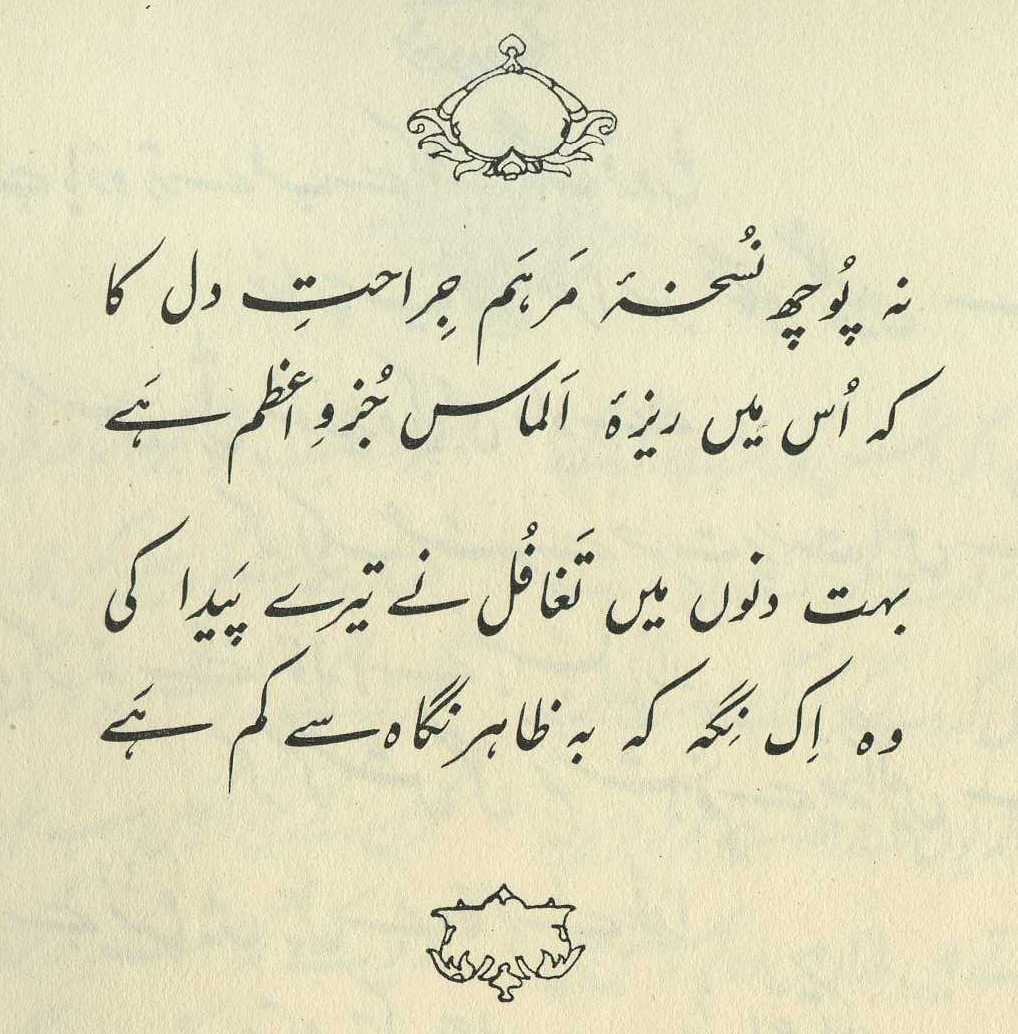
And the remaining elements are salt and musk-- that is, the things that would make a wound further increase. (222)
He says, 'For the wound of the heart, the prescription for salve that has been devised-- don't ask about it. Because in that prescription a great/major element of the medicines is a fragment of diamond.' The meaning is that for the wound of the heart, it's necessary to use a salve from which the wound would keep on increasing 'twofold by day, fourfold by night'. (280)
He says that the cure for the wound of the heart is death.
[Or:] If the meaning of 'wound of the heart' would be 'the wound of the pain of love', then the cure for love is that however much it would be increased, however much of the beloved's tormenting there would be to endure, it's so much to the good. (388)
Perhaps the diamond-fragment salve would be used to scrape or deepen the wound, either in a medical sense (to remove infected tissue, etc.), or else in a masochistic sense to heighten the pain/pleasure of the wound-- a purpose for which the lover often uses his fingernails, as in 15,8 and 19,1 .
But the use of the 'inexpressibility trope' ('don't ask!') with reference to the prescription creates a strong implication of something ominous ('you don't want to know!'). For the diamond-fragment is also an evocation of the bits of diamond that are used like a poison, to pierce the intestines and cause death from internal bleeding-- a very lover-like death, in fact. For the most conspicuous example of such a use, see 2,1 -- where the diamond is a 'gift' among wounds that are also 'gifts', so that suffering seems to be a gift-- but so does death.
In the present verse, suffering is part of the prescription-- but so is death. Are they parts of one single process (the lover suffers more and more severely, until he finally dies of the wound), or is death an antidote for suffering (the lover suffers so badly that he then seeks relief by ending his life)? In the world of the ghazal, with its pain/pleasure equations, it's hardly possible to tell the two outcomes apart.
graphics/diamonds.jpg