Verse 31816aaniimaa;Nge
G5
In this meter the first long syllable may be replaced by a short; and the next-to-last long syllable may be replaced by two shorts.
1
{such a / 'that'} heat of passion is the longing-- that again/then, like a candle
2
flame, as far as the pulse of the liver, would demand fiber-runningness
'Wish, desire, longing, inclination... ; request, prayer, supplication, petition'.
'Fibre; filament; nerve; vein (of a leaf)'.
'Running, walking fast'. (Steingass p.540)
| References | |
|---|---|
| Arshi, Imtiyaz Ali | Ghazal# 147 |
| Raza, Kalidas Gupta | 255-256 |
| Nuskhah-e-Hamidiyah | 213-214 |
| Asi, Abdul Bari | 226-227 |
| Gyan Chand | 344-346 |
| Hamid Ali Khan | Open Image |
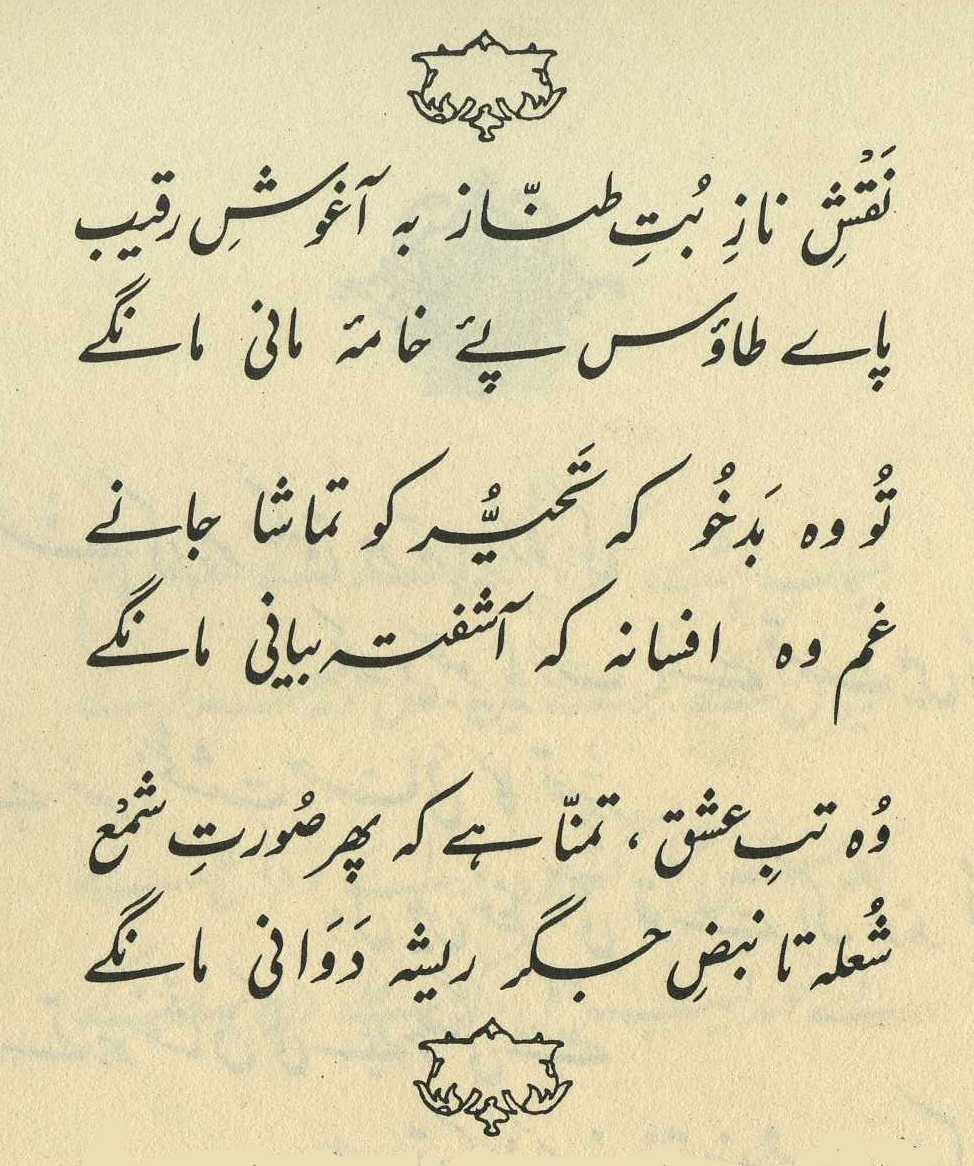
That is, I long for that heat of passion the fire of which, like the flame of a candle, would do 'fiber-runningness' down to the liver. To say 'the pulse of the liver' is not devoid of elaboration and [a need for] special pleading [], because there's no pulse in the liver. But here he has taken 'pulse' in the meaning only of 'vein', and by 'liver' is meant the inner part of the breast. In this aspect [], there's no unattractiveness in saying 'pulse of the liver'. (206)
== Nazm page 206

He says, 'I have a longing and yearning for such a heat of passion that its flame, like a candle, would run down to the liver'. (265)
Again I have a longing for such a heat of passion that its flame would convey its effect as far as the vein of the liver. That is, the way in the wick of a candle flame catches fire upward, and finally the wick of the candle burns, in the same way the flame of the heat of passion would burn me to ashes from head to foot. (Then he realizes that even previously such a thing had already happened.) (364)
The two lines show enjambment. The lover longs for a state in which 'flame' would demand or require, as in the case of (or literally 'with the aspect of') a candle, 'fiber-runningness' down as far as the 'liver-pulse'. The wick of a lighted candle steadily carries the flame down along its own 'fiber', guiding the flame ever deeper into the candle's heart (or 'liver-pulse') while its heat burns and melts everything in its path until it finally consumes the candle entirely.
Perhaps the lover no longer feels such 'heat of passion', and wistfully longs to know 'again' [] its deadly ravages; for another case of such nostalgia, see 234 . Or perhaps the lover does feel just such a 'heat of passion' building up, and only longs for it to reach its fatal culmination quickly and put him out of his misery.
Is this vivid imagery enough to sustain the verse? Well, not at any very high level. But the verse does also offer a nice touch of wordplay: looks exactly like (and sounds almost like) , a shortened form of , 'madness', that is used when poets need it for metrical reasons. (For a Mirian example, see M 949,6 .) And although the verse makes no specific reference to madness, the lover's 'heat of passion' is never all that far from 'madness in every fiber' in any case.
graphics/burningfiber.jpg