Verse 21816aaniimaa;Nge
G5
In this meter the first long syllable may be replaced by a short; and the next-to-last long syllable may be replaced by two shorts.
1
you're {the kind of / 'that'} bad-tempered one who would consider amazement [to be] a spectacle
2
grief is {the kind of / 'that'} story that would demand distracted expression
'Being astonished, confounded, or disturbed; astonishment; amazement; wonder'.
'Distracted, disturbed, distressed; disordered; uneasy, uneasy, wretched, miserable'.
'Declaration, assertion, affirmation; explanation, exposition, description, relation, disclosure, unfolding'.
| References | |
|---|---|
| Arshi, Imtiyaz Ali | Ghazal# 147 |
| Raza, Kalidas Gupta | 255-256 |
| Nuskhah-e-Hamidiyah | 213-214 |
| Asi, Abdul Bari | 226-227 |
| Gyan Chand | 344-346 |
| Hamid Ali Khan | Open Image |
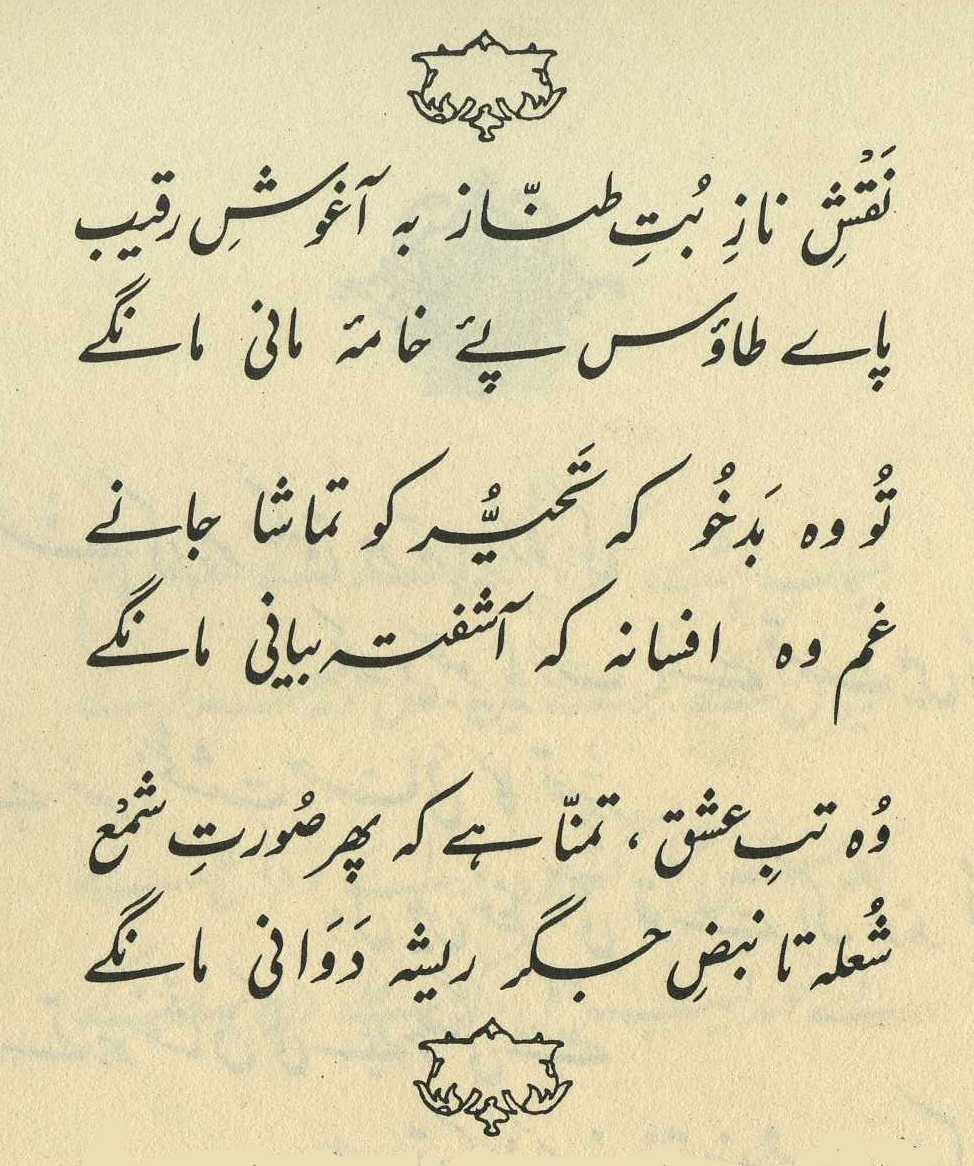
In amazement, it's necessary for there to be silence. The meaning is that if I remain amazed and silent, then you consider it a spectacle; and if I put aside astonishment and silence and bring to my tongue the grief of the heart, then you are disaffected with the 'distracted-expressing-ness'. (206)
== Nazm page 206

He says, 'In amazement, silence is required and necessary; and you're such a bad-tempered one that you consider my amazement and my silence to be a spectacle. And grief is the kind of story that for it 'distracted expression' and disorderedness of speech are appropriate. If I put aside amazement and silence and bring to my tongue the grief of the heart, then you are displeased and disaffected.' (266-67)
My life has fallen into great jeopardy. You're such a bad-tempered one that if I remain lost in excessive grief, then you consider it a spectacle, and my amazement has no effect on you. And if I don't narrate the story of grief, then you become angry at my 'distracted expression'. And in the state of grief, narrative necessarily becomes tangled. The gist is that neither by remaining silent, nor by telling the state of the heart, can I have any effect. (347)
This is a real 'catch-22' verse: there's no way out for the poor lover. The parallelism of structure between the two lines makes clear the two horns of his dilemma. The beloved is the kind who takes the lover's petrified, stupefied, silent state of 'amazement'-- on the nature of this state of see 51,9x -- to be a mere spectacle or show, so that she remains quite unmoved by it.
And the lover is also unable to put his suffering into words, because grief is a 'story' that can only be conveyed by 'distracted expression'-- a rush of disorderly, incoherent, half-crazed speech that is precluded by 'amazement' (and in fact is almost its opposite). So the lover can't get any benefit from option A, and he is also unable to make use of its opposite, option B. As so often, the lover ends up with the worst of all worlds.
graphics/writing.jpg