Verse 11816aaniimaa;Nge
G5
In this meter the first long syllable may be replaced by a short; and the next-to-last long syllable may be replaced by two shorts.
1
the shape/form/image of the coquetry of the playful/mocking idol in the Rival 's embrace
2
would require the foot of a peacock in place of the pen of Mani
'Playful, mirthful; --one who ridicules, a derider, mocker, scoffer'.
'Name of a celebrated (Chinese) painter'.
'Rare, uncommon'. (Steingass, p. 1145)
[from Sanskrit] 'Thinking, being of opinion, fancying, imagining... ; --proud, haughty, arrogant, disdainful; indignant, angry, resentful, sulky'.
| References | |
|---|---|
| Arshi, Imtiyaz Ali | Ghazal# 147 |
| Raza, Kalidas Gupta | 255-256 |
| Nuskhah-e-Hamidiyah | 213-214 |
| Asi, Abdul Bari | 226-227 |
| Gyan Chand | 344-346 |
| Hamid Ali Khan | Open Image |
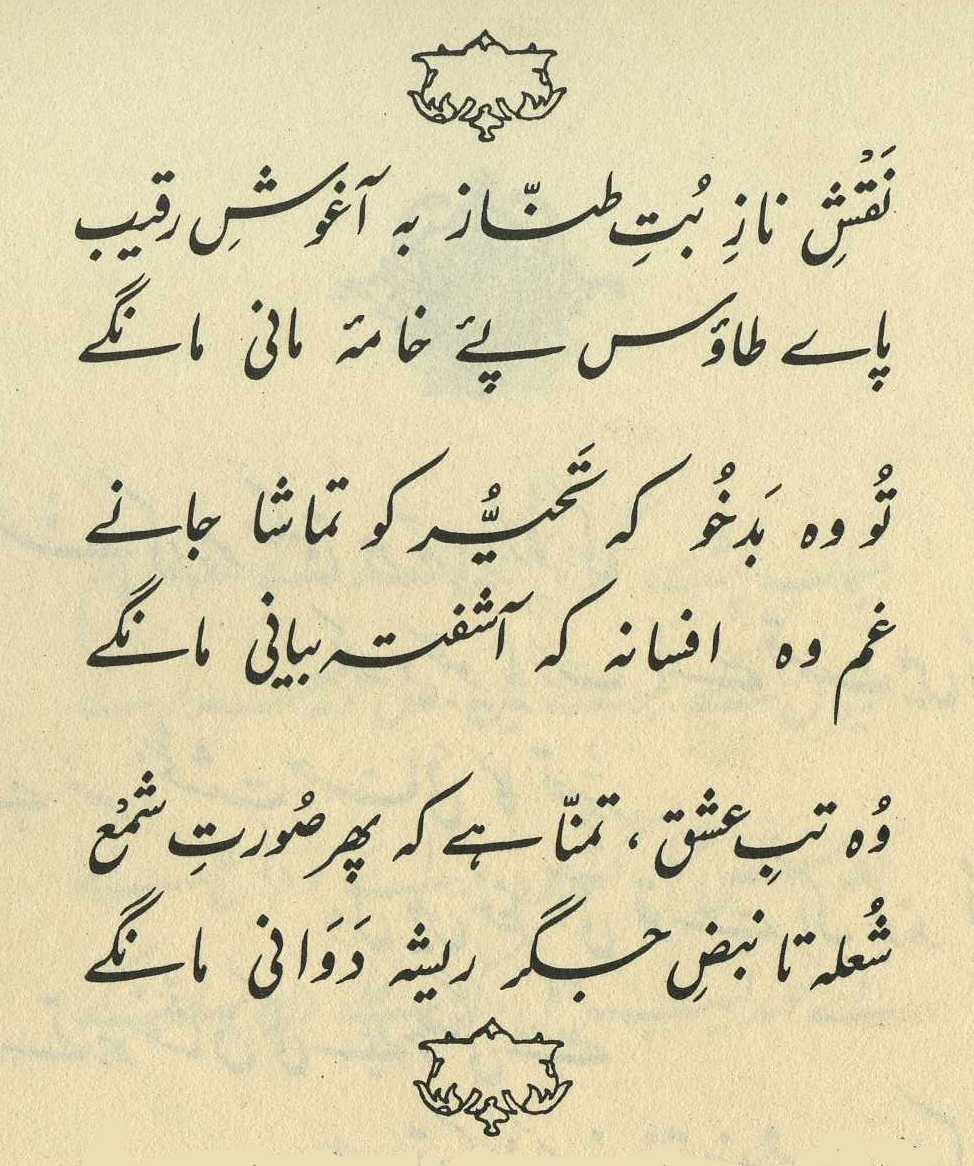
That is, having embraced the Rival, the image of her show of coquetry wants, instead of the 'hair of the pen' [], a pen of the 'foot of the peacock' to be in the painter's hand. The cause for similitude is that all the parts of the peacock are beautiful and a cause for pride and coquetry, but its foot is very unattractive and for its [=the peacock's] beauty is a cause of shame and defectiveness. (206)
== Nazm page 206

He says, 'The picture of that playful/mocking idol in the embrace of the Rival seems so ill-appearing and awkward that in order to capture it there needs to be a hair of the pen of the foot of the peacock in the hand of Mani'. The meaning is that the way a peacock's wings and feathers and limbs of the body are beautiful and attractive, and are an established cause for pride and coquetry, in the same way its feet are discolored and ugly and a cause of shame, and have appeared as a defect in its beauty and radiance-- in this same way, in the state of embracing the Rival, the state of her coquettish picture appears. (266)
If after embracing the Rival she would want to cause her picture to be captured, then instead of the pen of Mani a pen of the foot of a peacock will be suitable. That is, after union with the Rival the charm that was a peacock's wing no longer remains in her; rather, it has become a peacock's foot. (364)
This verse offers fine wordplay, and especially remarkable sound effects-- we have the juxtapositions of and ; and ; and , not to speak of all the alliteration and assonance.
But what else do we have? Trying to use the foot of a peacock as a pen would result in thick, awkward, ill-controlled lines; it could only be done playfully or mockingly. Obviously, for any serious writing one should use one of the peacock's feathers instead, and make a 'quill pen' out of it. Such awkward misuse of what can (and should) instead be used much more beautifully and effectively, is just what we see in the coquettish beloved as she embraces the Rival -- and does so playfully or mockingly, with one eye on the effect she's creating, not in any genuine or serious way.
Mani is the proverbial, archetypal 'great painter', and is often invoked as such in the ghazal tradition; his name also gives rise to an extended Persian meaning of 'rare, uncommon'. What about the Sanskritic ? It's got just the polyvalence Ghalib enjoys exploiting. I was tempted to suggest it; but S. R. Faruqi reminded me that such a Sanskritic word could never appear with an , so I'm out of luck.
Faruqi comments further (Feb. 2006):
'It's a stunning verse, if verses could be of one line only: the first line is marvellous. The second line has a good theme , but poor execution. The peacock's feet are supposed to be ugly, and he is supposed to weep when, while dancing, he happens to glance at them. So if somebody were to make a painting of the while she was in the embrace of the Rival, the painting would require not so much Mani's brush (for the beauty of the beloved) as the claw of the peacock (for the ugliness of the Rival).'
That's all very well, but I still have some kind of an uneasy feeling about this verse; I keep wondering if there could be more to it somehow.
graphics/peacockfeet.jpg