Verse 31826amaage
G16
1
the grief of the age/world swept away the intoxication of the joy/pleasure of passion
2
otherwise, even/also we formerly/afterwards used to experience the relish/pleasure of sorrow
t>> : 'Liveliness, sprightliness, cheerfulness, gladness, glee, joy, pleasure, exultation, triumph'.
'To support, bear, carry; to take upon oneself, bear the burden or responsibility of, undertake; to undergo, experience, suffer, endure'.
'Pleasure, delight, enjoyment; sweetness, deliciousness; taste, flavour, relish, savour;—an aphrodisiac; an amorous philter'.
'Pain, anguish, torment; grief, affliction'.
'In future, hereafter, henceforth, again; for the future; next in time or place, then, afterwards; thereupon, after that; formerly, in former times, already'.
| References | |
|---|---|
| Arshi, Imtiyaz Ali | Ghazal# 192 |
| Raza, Kalidas Gupta | 365-66 |
| Hamid Ali Khan | Open Image |
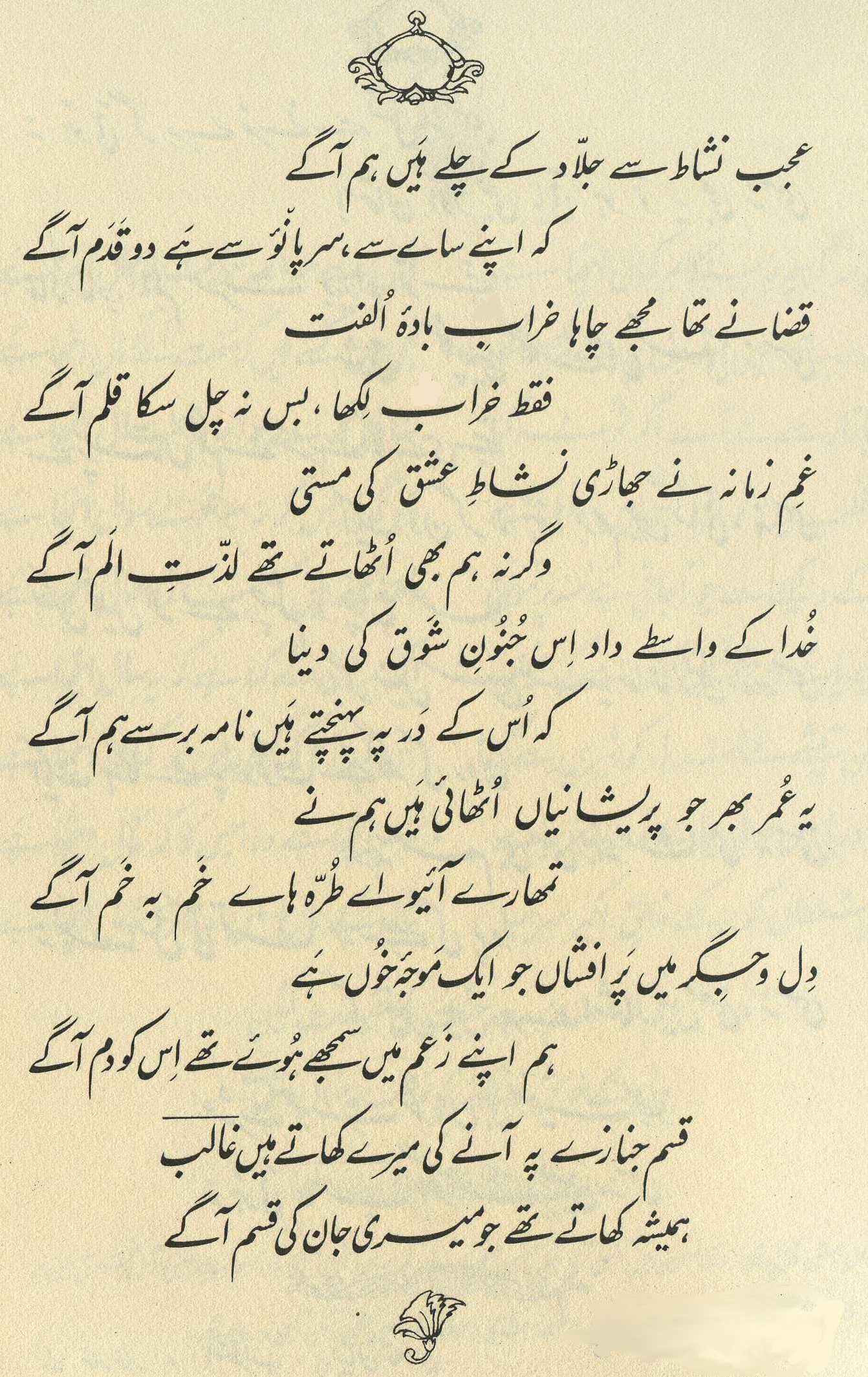
That is, the grief of the age has now removed all intoxication; otherwise, we too used to enjoy the pleasure of the grief of passion. (197)
== Nazm page 197

He says, the sorrow and grief of the world has overcome all intoxication; otherwise, we too used always to enjoy all the pleasures of passion. (255)
Alas, that the grief of the world has removed the intoxication of passion. Otherwise, we too used to take pleasure in the cruelty of the beloved. Mirza tells us that the joy of passion and the cruelty of the beloved are exactly the same thing. That is, in love the greatest source of pleasure is the beloved's cruelty.
[Or:] In the face of the grief of the world, the grief of passion does not endure. (346)
[See his comments on Mir's M 617,5 .]
This is another verse very cleverly engineered for ambiguity. The first line tells us that A swept away B; the second line tells us that before that happened, we used to experience C. Since both B ('the intoxication of the joy of passion') and C ('the relish/pleasure of sorrow') involve both delight and pain, and since A ('the grief of the world/age') consists of a form of pain, and 'to experience' [] is commonly used for 'to suffer, to endure' (see the definition above), it's hard to sort out what's actually happened. How much pain is there, and how much joy, and how did the whole process take place?
For in fact, all those multiply abstract constructions (plus one that works just as flexibly) leave tremendous room for alternative readings. We have to decide for ourselves the relationship of the two lines with their three abstractions. How directly or indirectly is the 'intoxication of the joy of passion' connected to the 'relish/pleasure of sorrow'? (All we know about their relationship is that the removal of the former seems to imply the loss of the latter.) And does the 'grief of the age' remove the 'intoxication' by itself replacing it (as Bekhud Mohani suggests), or does it simply 'sweep it away' by using some kind of metaphorical broom?
Even the little adds its own touch of complexity. Since the basic sense of is 'next to', by extension it can mean both 'formerly, in the past' and 'after that, thereupon' (see the definition above). By no coincidence, both temporal possibilities work beautifully with the first line.
If we take to mean 'formerly' or 'in former times', then the lover used to feel the 'relish/pleasure of sorrow' in the past, and now feels it no longer. This-worldly suffering, the 'grief of the age/world', has entirely swept away that former intoxication.
If we take to mean 'after that' or' thereupon', then the lover used to enjoy a sequence of two events: first the 'intoxication of the joy of passion,' and afterwards, or thereupon, the 'relish/pleasure of sorrow'. Apparently they went well together, and are remembered with nostalgia-- for alas, they belong to a time before the 'grief of the age' swept them both away.
Through juxtaposing 'grief', 'joy', 'relish/pleasure', 'sorrow' (in that order), and adding 'intoxication' (which can be a source of both joy and sorrow), and throwing in 'passion' (which is invariably a source of both joy and sorrow), and using a verb that fundamentally means 'to experience', the verse ensures that we'll be bouncing around among the ghazal's pain/pleasure contradictions and paradox es, grasping finally at the sameness-in-difference handholds that are all we have to anchor ourselves. In short, it's business as usual in the ghazal world.
graphics/sorrow.jpg