Verse 11826amaage
G16
1
with an extraordinary/strange joy we have moved ahead of the Executioner
2
{so that / since}, like our own shadow, the head is two steps ahead of the foot
'Wonderful, marvellous, astonishing, amazing, miraculous, strange, extraordinary, rare'.
t>> : 'Liveliness, sprightliness, cheerfulness, gladness, glee, joy, pleasure, exultation, triumph'.
| References | |
|---|---|
| Arshi, Imtiyaz Ali | Ghazal# 192 |
| Raza, Kalidas Gupta | 365-66 |
| Hamid Ali Khan | Open Image |
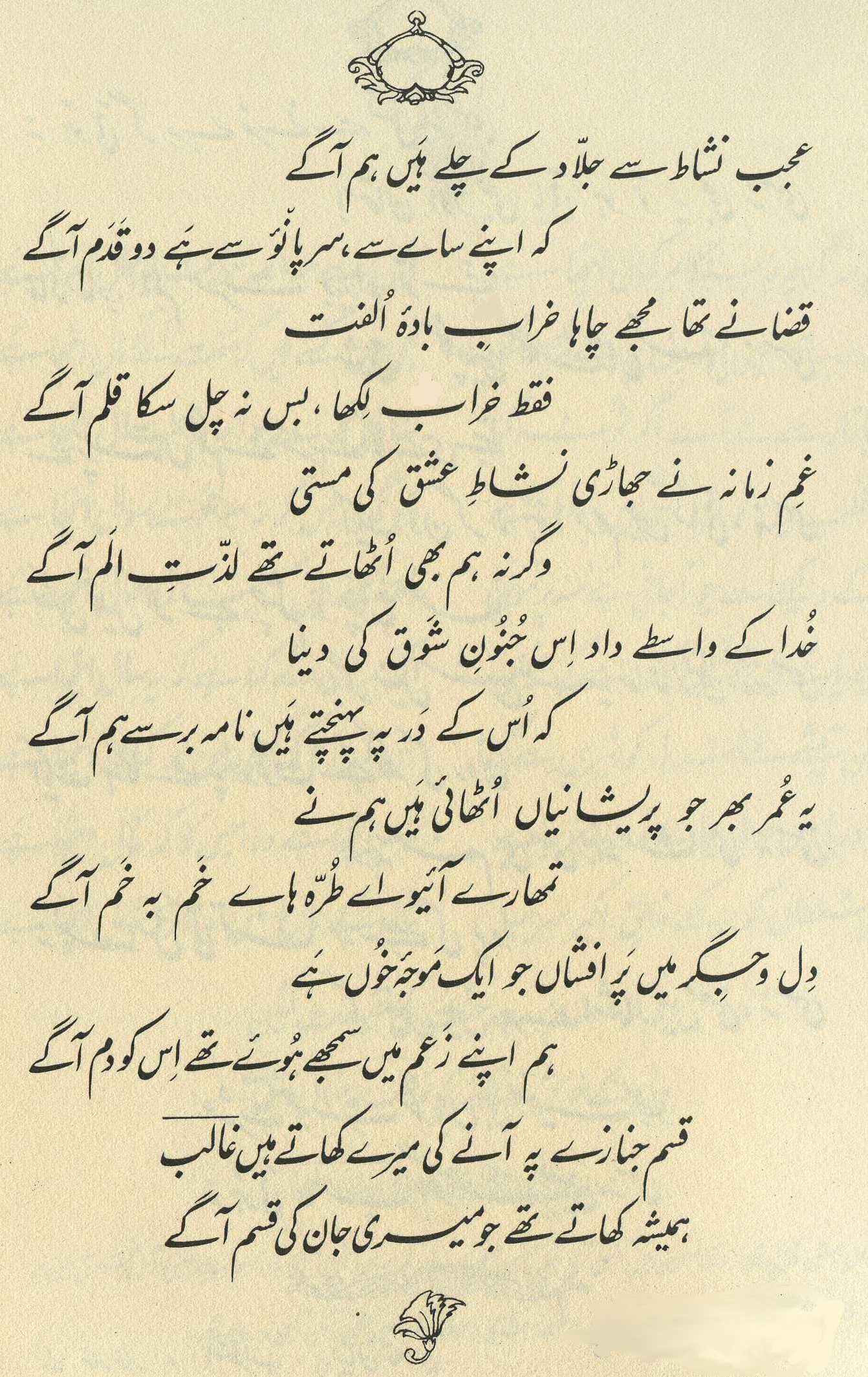
If the sun would be at the back of some walker, then the shadow of his head is somewhat in advance of his feet. That is, here the ardor for the slaying is such that like my shadow, my head is two steps in advance of my feet; as he has said previously, that 'door and walls have devoted themselves to their shadow' [an inaccurate reference to 58,7 ?]. (197)
== Nazm page 197

He says, 'We go running after the Executioner toward the execution-place with such happiness that as our feet are advancing very quickly in the ardor for execution, the shadow of our head is going two paces ahead even of them'. If the sun is situated toward the back, then the shadow advances ahead. (255)
We feel such happiness at being slain without any crime, by the order of the beloved or of some tyrant, that we are going ahead of the Executioner in the way that the shadow of our head goes two paces ahead of the shadow of our feet. (346)
Compare 45,4 . (171, 297)
This verse is a kind of study in the versatile little postposition . It occurs three times in the two lines, and each time in a different sense. The use in the first line is instrumental: 'with' an extraordinary joy; since Urdu is remarkably adverb-poor, such postpositional phrases with are very common where English would have adverbs.
Then in the second line two such phrases appear in close succession. The earlier case, , looks like a good candidate for 'by means of' the speaker's own shadow, which is also a standard use of the postposition. Only after reading the rest of the line do we go back and realize that in this context it can only be short for , 'like, in the style of' his own shadow. By contrast, the final case is straightforward: , 'from the foot', is another standard use of the postposition.
Thus the speaker walks ahead of the Executioner because of his eagerness to experience death. The analogy in the second line is to the way when someone walks with the sun behind him, his shadow falls ahead of him, so that the head of his shadow is farther away than (and thus ahead of) the foot of his shadow.
The multivalence of , which can mean either 'so that' or 'since', permits the causal relationship to run either way. Does his joy cause his shadow to mirror this eagerness, or does his shadow's movement inspire or embody his joy?
Also, of course, the idea that the head is somewhat separated from the feet is all too appropriate to a situation in which the speaker is about to be decapitated. And there's the related wordplay of 'head' and 'foot' and 'footstep'. Vivek Gupta points out (Feb. 2012) that in Arabic means 'activity', so that for Arabic-knowers there might be an extra layer of wordplay (for indeed our 'activity' is strange).
Arshi suggests a comparison to 45,4 , which is thematically apt. But I suggest looking at 208 , with its refrain of , to see all the clever ways Ghalib uses when he's in the mood.
graphics/shadow.jpg