Verse 11821abo;Nse
G13
1 a
in the gathering of idols, speech/poetry is vexed/displeased with the lips
1 b
in the gathering of idols, there is speech/poetry from vexed/displeased lips
2
we have become irritated/vexed with such flattery-seekers
'Afflicted (by, - ), sad, dispirited, sorrowful; vexed (with, - ), displeased, dissatisfied; weary (of, - )'.
'To be distressed or incommoded (by), to be in distress or difficulty; to be troubled, or vexed, or harassed (by); to be utterly weary or sick (of), to have one's patience exhausted (by); to be dejected or sad'.
| References | |
|---|---|
| Arshi, Imtiyaz Ali | Ghazal# 131 |
| Raza, Kalidas Gupta | 340-41 |
| Nuskhah-e-Hamidiyah | 179-181 |
| Asi, Abdul Bari | 216-217 |
| Gyan Chand | 331-332 |
| Hamid Ali Khan | Open Image |
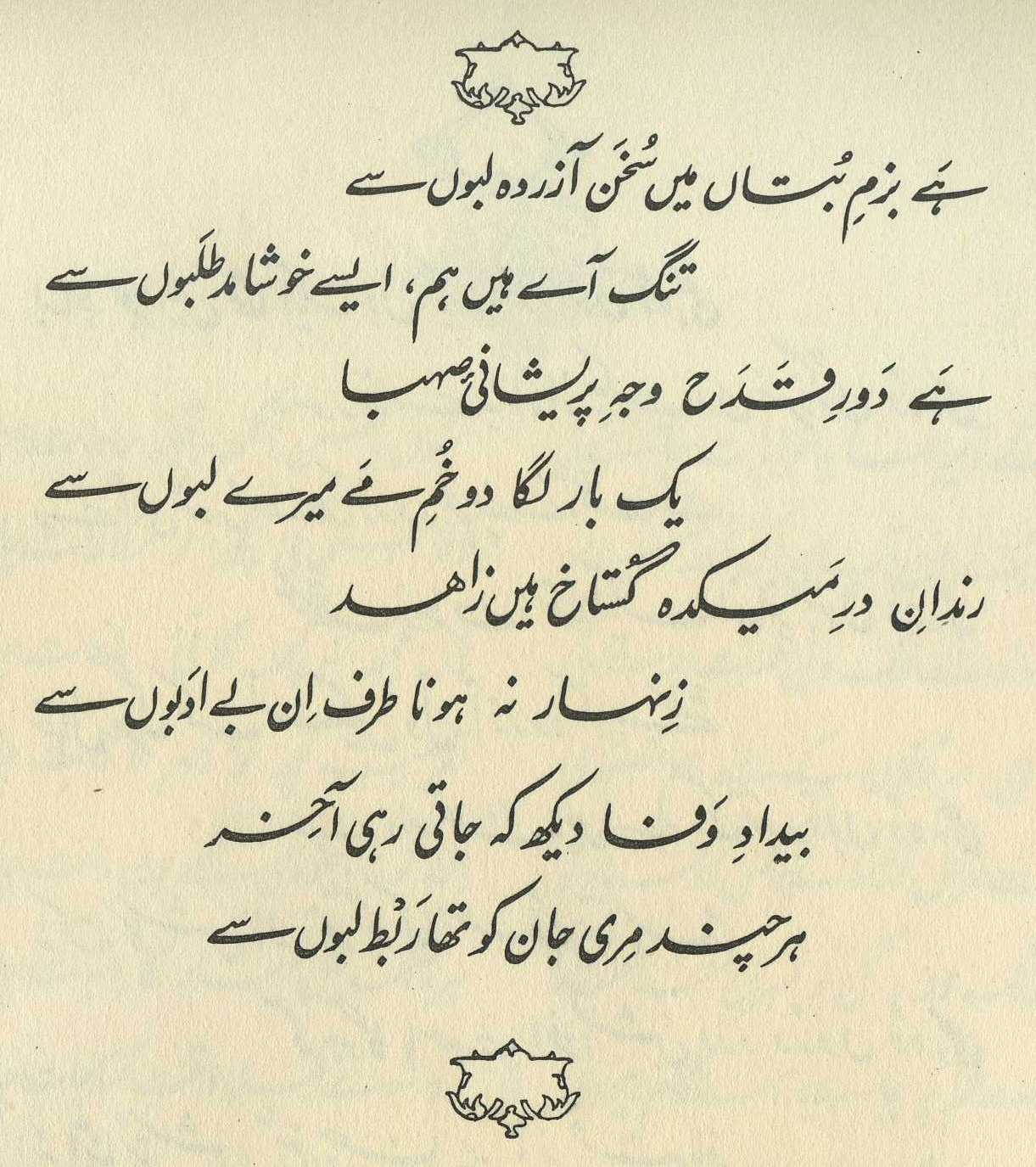
He has called speech a 'flattery-seeker'. That is, in the beloved's gathering, speech has become irritated with my lips. It wants to perform flattery, and to come as far as the lips. The gist is that before the beloved, words don't emerge from the mouth. Or he has called the beloved a flattery-seeker, such that while flattering and flattering her, speech has become disaffected with the lips. (143)
== Nazm page 143

A strange situation in the beloved's gathering is to be seen. Here when we look, we see that speech is vexed with the lips. That is, whoever is there is seated with the seal of silence on his lips. We are tired of such flattery-seekers, our heart wants to open itself and speak, and enjoy the pleasure of the company. But here it's a different world. (265)
The best solution is that 'flattery-seeker' is not a description of the beloved, but rather of speech. In such a situation, the word 'vexed' [] too becomes more powerful, because nothing has occurred to show that the beloved's awesomeness would prevent a voice from emerging, and we would say that speech is vexed or angry with the lips. Thus the better approach is that having arrived in the gathering of the idols, words and speech find their minds lifted up to the sky. The beloved always remains vexed/disaffected anyway-- that is, she doesn't pay that much attention. Now speech too becomes vexed: 'We want to speak, but speech doesn't emerge from our mouth, we remain seated, rapt and entranced'.
Two questions can emerge about this. The first is, having arrived in the gathering of the idols, why does the mind of speech rise to the sky? And [the second question is that] 'flattery-seekers' is plural-- how would it be said to describe 'speech', which is singular? The answer to the first question is that everything conspires against the lover. Even when somehow or other he manages to obtain entry to the beloved's gathering, then speech conspires against him-- that is, he no longer has the power of speech. It's as if words are seeking to be flattered, to induce them to take the trouble of coming to the lip.
The answer to the second question is that the idiom is just this: in order to create force in speech, the plural would be used instead of the singular. 'I am irritated with people'-- that is, 'I am irritated with you'-- is an everyday idiom. The pleasure of the verse is in the fact that speech, which won't come to the lips, has been called a 'flattery-seeker'. It's clear that flattery is done only by means of words. If words are used, then speech will spontaneously occur. Thus even flattery is impossible. That is, in the gathering of idols, it's impossible to open one's lips.
== (1989: 254-55) 2006: 276-77
Each line is a separate statement, and it's left up to us to decide what their relationship is. The second line, at least, is relatively simple: the speaker is fed up with 'such flattery-seekers'. Faruqi's point about the plural form having a colloquial effect (of indirection and dark sarcastic muttering to oneself) is excellent. The flattery-seeker could thus in fact be singular, and pluralized merely for rhetorical effect. So far so good. What kind of flattery-seeker(s) is the speaker fed up with? The first line offers us several candidates; taking them in order, they are: (1) the idols (that is, the beautiful beloveds, who are often treated as plural for no particular reason-- unless perhaps for the effect mentioned by Faruqi above); (2) speech; (3) the lips. By no coincidence, the 'midpoint' word is perfectly positioned so that it can describe either 'speech' (1a) or 'lips' (1b). Let's consider the three possibilities:
(1) The idols, or beautiful beloveds, could be flattery-seekers: they keep hordes of lovers around them in the gathering, and encourage their devotees to outdo each other in praise and devotion. Even as the lover mutters darkly about his fed-upness, we notice that he's muttering right from within the idols' gathering; he hasn't left, or even ceased to speak, though he does claim that his speech comes from vexed lips, as in (1b). A weakness of this reading: where in the verse itself is the 'proof' or evidence that the idols are flattery-seekers?
(2) Speech itself could be a flattery-seeker. That's why it emerges from 'vexed' lips (1b). The lover considers it ostentatious and vulgarly self-promoting-- even if it's his own speech, and even if it's required by the social situation. He begrudges every word. Or perhaps the words, vain and ambitious, insist on emerging against his will and despite his vexed efforts to contain them. For after all, in the presence of the beloved, one should be silent, in a kind of mystical rapture (see 116,5 ).
(3) The lips could be flattery-seekers, and then it's speech that is vexed and displeased with them. In such a gathering, speech wants to restrain and refine itself, to withhold itself. Or perhaps to make itself felt in other ways-- but how exactly? Through humility rather than eloquence? Through silence rather than a voice? Through deeds rather than words? Through some direct communion between the lover's heart and the beloved's? Compare 131,9 .
And then of course, 'speech' [] is so often (perhaps more often than not) used to refer to poetry, as in 33,4 , 50,3 , and many other verses. That's in fact my own best suggestion for making meaning from this somewhat problematic verse. The intimate connection of one's own 'poetry', recited before one's beloved, with a desire for flattery, can hardly be missed; it's much more potent than that of mere 'speech'. And the desire for flattery can go either way: the beloved can desire flattery through the poetry (both in its content, and by the very fact of its composition and recitation); and the poet-lover can desire to hear flattery of his poetry from the beloved.
Still, it doesn't fit together as brilliantly, or with such an audible 'click', as many of his verses do. It feels almost like a puzzle with a piece missing.
graphics/lips.jpg