Verse 11816aakhai
G3
1
intoxication with the relish of the negligence/drowsiness of the Cupbearer is destruction/destroyed!
2 a
a wave of wine is a single sleepy/drowsy eyelid
2 b
a single sleepy/drowsy eyelid is a wave of wine
'Unmindfulness, forgetfulness, neglectfulness, negligence, neglect, inattention, heedlessness, inadvertence, remissness, carelessness; --soundness (of sleep), unconsciousness, drowsiness, stupor, insensibility, a swoon'.
'Perishing; being lost; --perdition, destruction, ruin; --slaughter; death; --part. Lost; destroyed; --fatigued'.
| References | |
|---|---|
| Arshi, Imtiyaz Ali | Ghazal# 172 |
| Raza, Kalidas Gupta | 263 |
| Nuskhah-e-Hamidiyah | 261-262 |
| Gyan Chand | 465-466 |
| Hamid Ali Khan | Open Image |
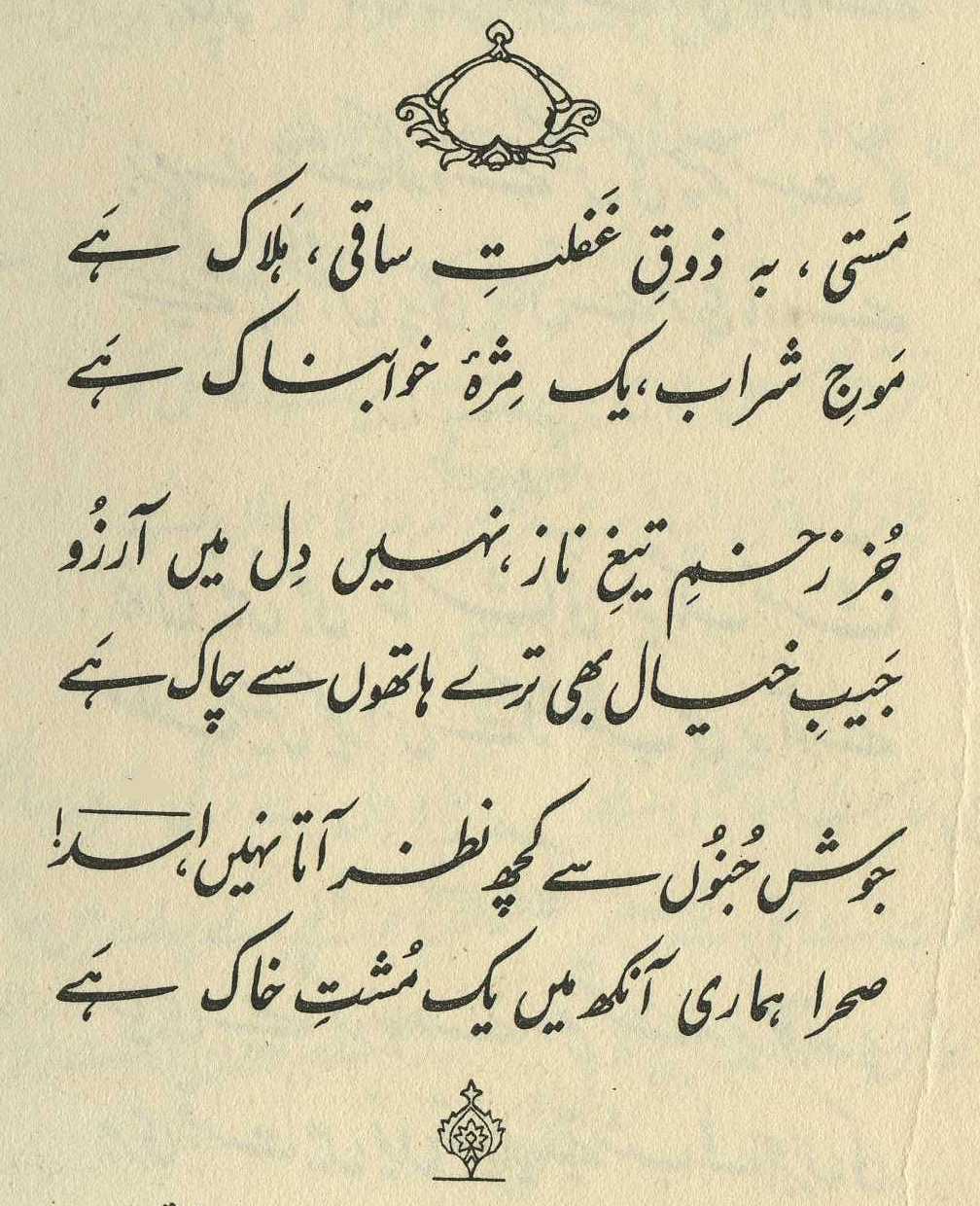
The Cupbearer's style of displaying negligence has destroyed intoxication as well, and with this relish and ardor the wine is becoming so self-less and overflowing that the wave of wine is a sleepy eyelid on the eye of the wineglass. (251)
== Nazm page 251

He says, 'The airs and graces of the Cupbearer's show of negligence are destroying intoxication too, and the wave of wine, in this relish and ardor, has become self-less and overcome, and has become a sleep-filled eyelid of the wineglass'. (309)
The relish of the negligence of the Cupbearer has destroyed intoxication. That is, intoxication too has been erased by the Cupbearer's style of negligence. The wave of wine too has become a dream of wine.
The clear meaning is that the Cupbearer has neglected to show kindness to the rakish ones. The result of this was that there's no trace of intoxication anywhere, because nobody's been vouchsafed even a drop of wine; if there would be intoxication, then how would it come about? Not only this, but the condition of the wine itself is become the same, as though someone's eyes would be becoming sleep-filled and his eyelids would be fluttering/drooping.... The gist is that not to speak of living creatures, lifeless things too were not protected from the effect of the Cupbearer's negligence.
[Disagreeing with Nazm:] If someone wouldn't understand by himself, then no matter what one says to him, he can't write a commentary. He's said that much, but he hasn't been able to understand the point of the verse. (453-54)
The clever use of means that the clause it introduces could be either restrictive and adjectival ('intoxication-with-the-relish-of-the-Cupbearer's-negligence is destruction') or unrestrictive and adverbial ('intoxication is destruction, with/through the relish of the Cupbearer's negligence').
Then, can mean, as one possibility, 'destruction'; in this sense it can share the idiomatic usage of 'Doomsday' [] or 'disaster' []. It can thus be used in an admiring and complimentary way, to praise someone's irresistible and deadly beauty (among many examples, 10,11 comes to mind). Here, that sense seems to be invoked by the word 'relish, taste' [], which precludes the possibility of taking the verse as a complaint about the 'negligence' of the Cupbearer in not providing wine. That 'negligence' obviously has a 'relish' of its own. Alternatively, can also mean 'destroyed' (see the definition above), the reading that the commentators prefer.
In the second line, the grammar creates a marked effect of 'symmetry': we can read either 'A is B' or, with equal felicity and legitimacy, 'B is A'.
If we put various ones of these mix-and-match possibilities together, here are some of the possible readings that result:
=Intoxication-with-the-relish-of-the-Cupbearer's-negligence is destruction: there's no need for wine, since a single flicker of the Cupbearer's negligent eyelid is enough to 'wreck' you like a wave of wine.
=Intoxication, with the additional relish of the Cupbearer's negligence, is destruction: simple intoxication with wine is quite enough in itself, but when it's compounded with the relish of the Cupbearer's negligence, the effect is devastating indeed: a single flicker of the Cupbearer's negligent eyelid is as overpowering as an additional wave of wine.
=Intoxication in the rakish ones, through the relish of the Cupbearer's negligence, is destroyed: the rakish ones are so overpowered by the relish of the Cupbearer's negligence that they no longer even think about drinking or intoxication: to them, even a wave of wine is nothing more than an evocation of the Cupbearer's drowsy/negligent eyelid.
=Intoxication itself, through the relish of the Cupbearer's negligence, is destroyed: the essential 'wave of wine', overcome and lulled by the charm of the Cupbearer's own drowsiness/negligence, doesn't slosh around enticingly in the wineglass but seems to ripple gently, like an eyelid flickering over a drowsy or indifferent eye.
A helpful bit of wordplay is the double meaning of ;Gaflat as both 'negligence' or 'heedlessness' in general, and something like 'drowsiness' or even a 'swoon' (see the definition above). Thus in the latter meaning, it may influence the 'sleepy, drowsy' [] eyelid to imitate it; Bekhud Mohani speaks of 'a dream of wine'. And of course, the Cupbearer's 'negligence' may also be feigned; such a show of assumed indifference would then become part of his coquetry, and would redouble the effect of his flirtatious charm.
Still, after the various possibility- threads have been spun out and duly appreciated, the verse isn't all that compelling. The equation of a 'wave of wine' with a 'drowsy eyelid' is so forced, and so implausible, that it has a kind of show-off quality: 'How clever I am to think of something as bizarre as this!'
graphics/winewave.jpg