Verse 3x1816aa))iihai
G5
In this meter the first long syllable may be replaced by a short; and the next-to-last long syllable may be replaced by two shorts.
1
through the garden of the silence of the heart, the speech/poetry of passion, Asad
2 a
the burnt breath is the enigma/suggestion of garden-adornment
2 b
the enigma/suggestion of garden-adornment is the burnt breath
'Sign, indication, nod, wink, hint, insinuation, innuendo, ambiguous expression, double entendre, mysterious allusion, riddle, enigma; sarcasm, irony'.
| References | |
|---|---|
| Arshi, Imtiyaz Ali | Ghazal# 204 |
| Raza, Kalidas Gupta | 257-58 |
| Nuskhah-e-Hamidiyah | 242-243 |
| Asi, Abdul Bari | 300-301 |
| Gyan Chand | 442-443 |
| Hamid Ali Khan | Open Image |
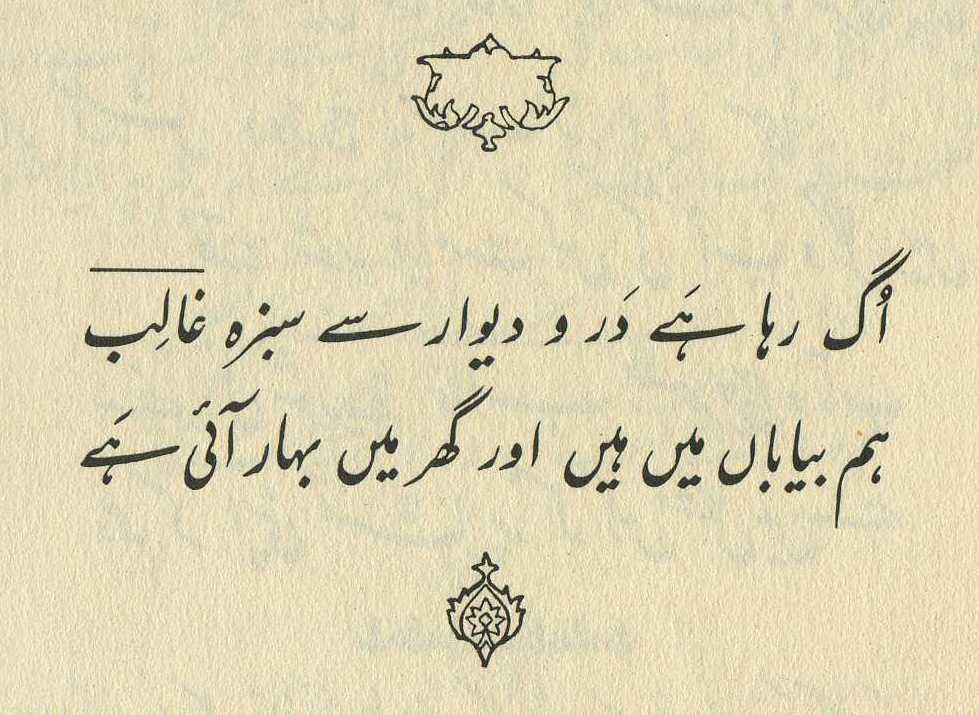
= the dead heart, or the melancholy heart of which the feelings have already died; the poet constructs it as the 'garden of silence'-- that is, the autumn-stricken garden. And he says that from such a heart emerge lover-like verses. The second line expresses surprise-- for the poetry of passion to emerge from such a dead heart is as if the burnt breath would be a cause of garden-adornment.
[Or] it's possible that Mirza might have expressed the actual cause of growth and flourishing [which is] carbonized grass. From exactly these burnt hearts emerge some 'hot' verses.
== Zamin, p. 432
= From 'silence' there is an implication that the silence of the heart is like a garden from which the poetry of passion is bursting out. My silent breath is an enigma/suggestion that is gesturing toward garden-creation. This garden will be created through verse and poetry.
== Gyan Chand, p. 443
For background see S. R. Faruqi's choices . This verse is NOT one of his choices; I thought it was interesting and have added it myself. For more on Ghalib's unpublished verses, see the discussion in 4,8x .
This was the original closing-verse of the ghazal; it was then replaced in the divan by 156,1 , which used 'Ghalib' rather than 'Asad'.
Zamin thinks of a 'silent garden' and then construes it as a dead one (presumably on the analogy of an extinguished candle as 'silent'). But the verse imagines the 'garden of the silence of the heart', and identifies it as a source of 'speech' or poetry, without any particular overtones of death. The breath is apparently burnt by passion, and it itself is an 'enigma' or 'suggestion' (or a 'mysterious allusion'-- see the definition of above)-- to the adornment of a garden. Out of the heart's silence comes speech/poetry; out of the breath's burntness comes a gorgeously adorned garden.
How are the initial garden [] in the first line, and the later garden [] in the second line, to be connected? Is there a kind of feedback loop, like a snake that swallows its own tail? Or does the 'silence of the heart' produce the garden, while the lover's 'burnt breath' adorns it? As so often, Ghalib has left us to decide for ourselves.
Compare 156,2x , which also links 'garden-adornment' to the 'breath'.
On the nature of , see 15,6 .
graphics/firebreath.jpg