Verse 111853anko
G2
1 a
can we not compose/'say' poetry-- that we would be a seeker of jewels [instead]?
1 b
what's the idea?! you can't say that we would be a seeker of jewels!
1 c
it's hardly [mere] poetry/speech!-- can we not say that we would would be a seeker of jewels?
2 a
don't we have a liver-- that we would go and dig in a mine/quarry [instead]?
2 b
don't we have the guts/courage to go and dig in a mine/quarry?
'Speech, language, discourse, word, words; --thing, business affair (syn. )'.
'The liver; the vitals; the heart; mind; spirit, courage'.
| References | |
|---|---|
| Arshi, Imtiyaz Ali | Ghazal# 126 |
| Raza, Kalidas Gupta | 439-40 |
| Hamid Ali Khan | Open Image |
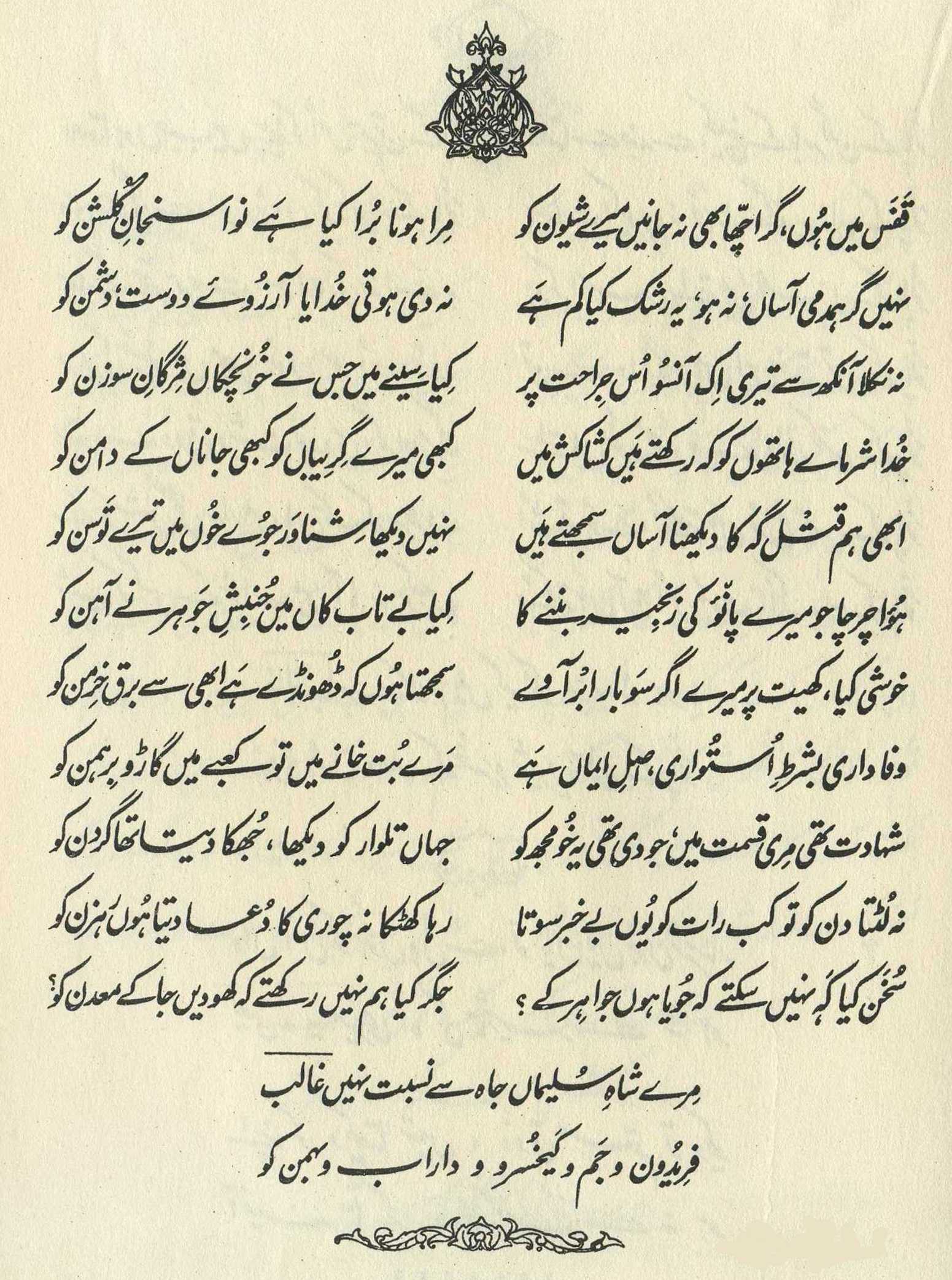
That is, to abrade the liver and bring out damp/fresh [] verse is better than to dig in a mine and bring out jewels. (129)
== Nazm page 129

He says, to make metrical verses through trouble/anxiety [] is of a higher rank than to dig in a mine and bring out jewels. (183)
He has beautifully said that verses are better than jewels and trouble/anxiety [] is better than digging in a mine. (244)
The parallelism of structure suggests the obvious meanings (1a) and (2a), two indignant rhetorical questions that are hard to translate both accurately and lucidly in English. 'Can't we compose poetry?! (Of course we can!) So why would we do an inferior thing like seeking jewels?' Similarly: 'Don't we have a liver?! (Of course we do!) So why would we do an inferior thing like digging in a mine?' The commentators all paraphrase the implication: that composing poetry is better than seeking jewels, and digging into one's liver (for poetic emotions or effects) is better than digging in a mine (for jewels).
But surely no one who knows Ghalib would expect the verse to stop with anything so one-dimensional. The first line begins after all with the doubly multivalent , which is open to at least a couple of alternative readings. If the expression is taken to be like [] (1b), then it marks an exclamation of astonishment or even indignation: 'What's this that you say?!', 'What an idea!'. And it's then very plausible to imagine the rest of the utterance addressed to someone else, since no subject is present in the verse, and the masculine plural verb could easily apply to some -- someone who has insulted the speaker, perhaps, by suggesting that he was merely a jewel-miner. Alternatively, the phrase can suggest that what is being called 'poetry' is not really a mere form of words at all (1c), but in fact is something much more valuable-- something like jewels, mined with trouble and pain from deep within. (For a comparable usage see 20,6 .)
Similarly, in the second line the obvious first interpretation can be reimagined so as to yield another possibility: can mean 'to have heart/courage/guts' (for something). So the speaker might also be indignantly rejecting the idea that he didn't have the guts to go dig in a mine (2b), perhaps in order to wrest from the depths the real 'jewels' of poetry (1c).
In short, the search for poetry either isn't, or is, like the search for jewels. (And even if it is, the search for jewels itself at once becomes a metaphor for the search for poetry.) More permutations could be devised, but the ones I've outlined at least suffice to show the complexity of the possibilities. We're left to mix and match to our own taste, every time we encounter the verse.
graphics/treasure.jpg