Verse 11833
G3
1
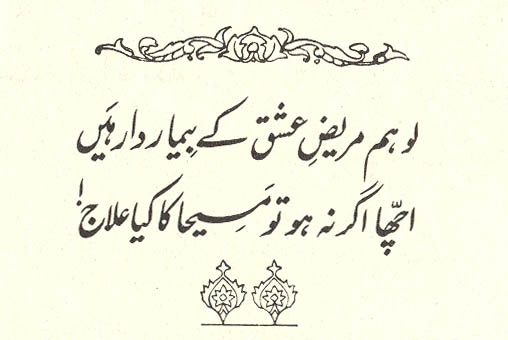
behold-- we're the nurse of a passion-sick one!
2
if he would not be well/'good', then-- 'what cure for the Messiah ?!'
'Look! behold! lo! there now! take that! what do you say to that!'.
| References | |
|---|---|
| Arshi, Imtiyaz Ali | Ghazal# 55 |
| Raza, Kalidas Gupta | 380 |
| Hamid Ali Khan | Open Image |
In an idiom they say, 'If this is not done, then what cure for you [
]?'-- that is, how should we treat you then, and what punishment should be given to you? And in this verse he has used the idiom in a manner extremely full of
affinity
. The verse is multiply meaningful [
] -- that is, it offers proof for these meanings as well: You people who say 'What cure is there for our passion-- we ought to have the Messiah cure it!'-- look, this is how I respond. (50)
== Nazm page 50

All right, we're the nurse for one sick with passion. But when it is clear that he will not recover, then 'what cure of the Messiah?'-- that is, the Messiah's cure is useless. (52-53)
He says, the beloved accuses the passion-sick one of having no nurse to give him medicine at the right time and make him eat foods he avoids, so that through heedlessness and recklessness the disease increases. Mirza Ghalib says, we will become the nurse of those sick with passion, and take responsibility for overseeing their medicine, etc. But first this ought to be decided: if the one sick with passion does not recover-- that is, if not even the medicine of union causes his disease of passion to abate-- then what punishment should be devised for the Messiah, that is, the beloved? Mirza Sahib's claim is that the disease of passion can't be cured in any way. (95)
If the sick one is not cured, then what [honor] will remain for the Messiah? (120)
Others too have used this theme .... but Mirza has composed this verse, and especially the first line, apart from all the rest, in an absolutely untouched style. (130)
This verse, like 54,1 , turns on the witty, multivalent use of an idiomatic expression. And as in that case, it seems that the commentators don't agree on how to understand the idiom (though I'd go with Nazm's meaning over the others). And also as in that case, it seems that the verse can still be effective even if we aren't entirely sure about the original idiom.
The first clause in the second line colloquially omits the subject, but it's definitely masculine (because of ) and singular (because of ). Thus two possibilities present themselves-- the patient, and the Messiah:
='If he (the patient) wouldn't recover or be well, then what cure of the Messiah?' could mean that if the Messiah can't cure the patient, then (1) What punishment can (or should) be inflicted on the Messiah for his failure?; (2) Can anybody improve on his treatment?; (3) Does he have any curative ability at all?
='If he (the Messiah) wouldn't be well or healthy himself, then what cure of the Messiah?' would open a new set of readings. If the Messiah can't cure himself, then (1) Can he possibly cure anybody else?; (2) Is it possible to punish him for such a failure?; (3) Can anybody else cure the Messiah?
We also know that the speaker, the lover himself, is just as much a 'passion-sick one' as the patient he undertakes to nurse. This makes his role as Messiah or physician doubly problematical. If he can't cure himself, how can he cure anybody else? And if he fails to cure the patient, how, in his condition of illness, can he be blamed?
As Bekhud Dihlavi points out, the Messiah could also be taken to be the beloved herself, while the speaker, the lover, merely offers himself as a nurse. In this case, his use of the idiomatic phrase would be a way of disavowing responsibility for the result, as though he already foresees a fatal outcome.
No matter what reading we adopt, that colloquial suggests some kind of ongoing argument or discussion, with perhaps a touch of exasperation on the speaker's part. And surely, in the whole verse, there's an obvious playful enjoyment of such witty manipulation of a familiar proverb.
graphics/messiah.jpg