Verse 11816araave
G13
1
even/also I am a spectator of the wonder/trickery of longing
2
there isn't any intention from this, that only/emphatically an intention would come to fruition
'Fascination, bewitching arts, wiles; magic, sorcery; deception; --deceit; trick; pretence; evasion; --freak; --a wonderful performance, a miracle; anything new or strange'.
'Wish, desire, longing, inclination (=); reqnest, prayer, supplication, petition'.
tlab>> : 'A question, demand, request, petition; proposition; wish, desire; object, intention, aim, purpose, pursuit, motive'.
'To be successful, to prosper; ... ; to prevail (against), overcome'.
is an archaic form of ( GRAMMAR )
| References | |
|---|---|
| Arshi, Imtiyaz Ali | Ghazal# 197 |
| Raza, Kalidas Gupta | 270-71 |
| Nuskhah-e-Hamidiyah | 271-272 |
| Gyan Chand | 479-481 |
| Hamid Ali Khan | Open Image |
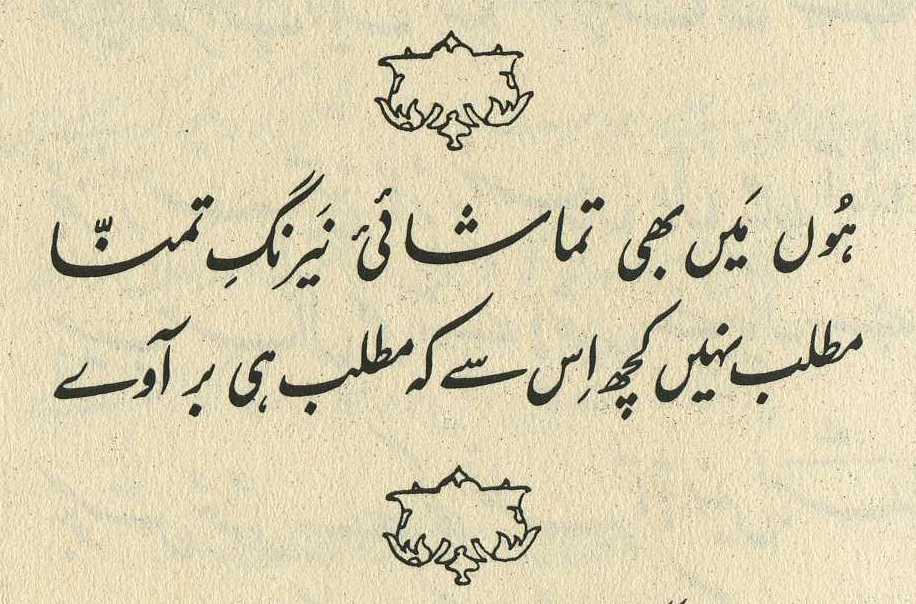
That is, I felt the longing so that I would know what pleasure there is in it; I have no longing at all that the longing would actually be fulfilled. (253)
== Nazm page 253

He says, I am only a spectator of the marvel of longing. That is, I want to see how longing changes its color/mood, and what kind of pleasure it bestows on the heart. My goal is not that my goal itself would be fulfilled. (310)
In this verse two words are meaningful: and . The meaning of is that the way other people want to watch a spectacle, in the same way I too want it. By the intention is that if the longing would be fulfilled, then it's unspeakably good []. If it wouldn't be fulfilled, even then I won't be particularly grieved. (459)
The possibilities of give us two readings of the first line: either 'I too' (who am like other people), or else 'even I' (who am in a class by myself). And what is this 'I' doing? He's a 'spectator' no doubt, maybe just an ordinary guy in a crowd, but what is he watching? The possibilities include a magic show, or a deception, or a freak, or a miracle, or a novelty (see the definition of above), which itself is associated with 'longing' in one of several flexible ways (constituting, owned by, pertaining to).
That first line certainly gives us a good Ghalibian start. And when, after a suitable mushairah -performance delay, we hear the second line, it turns out to be a worthy successor to the first: it goes even farther in offering us a great show of apparent simplicity (plain vocabulary and grammar, ordinary sentence structure, repetition) that can't be prevented from giving rise to unresolvable complexity. The moment we scratch the surface, all kinds of possibilities come fluttering out like endless scarves from a magician's hat.
'From this' [] alone works as a quite sufficient complexifier: undoubtedly it applies to something in the first line, but what exactly? From, or because of, the speaker's spectatorship? Or the wonder/trickery itself? Or the longing? Needless to say, we're left to decide for ourselves.
And then, the basic word (see the definition above) can have a quasi-public meaning (a 'demand' or 'petition' or 'proposition' that might also be presented to others), or a private emotional meaning (a 'wish' or 'desire'), or a sort of volitional meaning (an 'intention' or 'purpose' or 'motive'). So: roughly, from 'this' there's no intention/purpose.
But we're not through yet. The signals a new clause, with various possible relationships to the previous one. One obvious relationship would be explanatory: the new clause might tell us what kind of intention doesn't exist. And indeed it does: there's no intention that an intention would come to fruition. Plus of course the flexible little , that is either exclusionary ('an intention alone', as opposed to other things that might come to fruition as well) or emphatic ('an intention', as opposed to other things that might come to fruition instead).
If we prune the thicket of possibilities as much as we can, it seems that the speaker is offering a cleverly cynical defense or excuse: that he's simply watching the magic show for amusement, but of course he's not naive, he doesn't expect anything to come of it. Such an excuse may be genuine; or, as we all know from our own lives, it may have been hastily cobbled together as a face-saving device.
But there's another reading too: can also mean 'so that'. On this reading, we have something like the idea that the speaker has no purpose-- so that his purpose would be fulfilled. If the purpose of an activity is nothing, and indeed nothing results from the activity, then the purpose of the activity has in some sense been fulfilled. It's a transparent logical quibble, like the classic proof that an open oyster is better than heaven ('an open oyster is better than nothing; and nothing is better than heaven').
What the speaker is using-- in many possible permutations and with many different possible nuances and subtleties-- is some kind of a tactic of desperation. And in this whole verse, can't we just smell, or even taste, the desperation? He's desperate to hide from us, and even from himself, both the urgency of his longing, and his all too certain knowledge that the longing is in vain.
graphics/magic.jpg