Verse 2x1816ii;Nhai
G2
1
the desert of oblivion is after the desert/wilderness of searching, Ghalib
2
the sweat-steed of courage, then, is the torrent/stream of the 'saddle-chamber'
'Mortality, frailty, corruption, decay, perdition, destruction, death; —adj. Passed away, departed, deceased, defunct; non-existent, extinct'.
'A desert, waste, wilderness; a jungle, forest; a plain'.
talab>> : 'Search, quest; wish, desire; inquiry, request, demand, application, solicitation; sending for, summons; an object of quest, or of desire'.
'A flowing; a flow of water, a torrent, a current'.
| References | |
|---|---|
| Arshi, Imtiyaz Ali | Ghazal# 174 |
| Raza, Kalidas Gupta | 272-73 |
| Nuskhah-e-Hamidiyah | 262 |
| Asi, Abdul Bari | 265-267 |
| Gyan Chand | 388-390 |
| Hamid Ali Khan | Open Image |
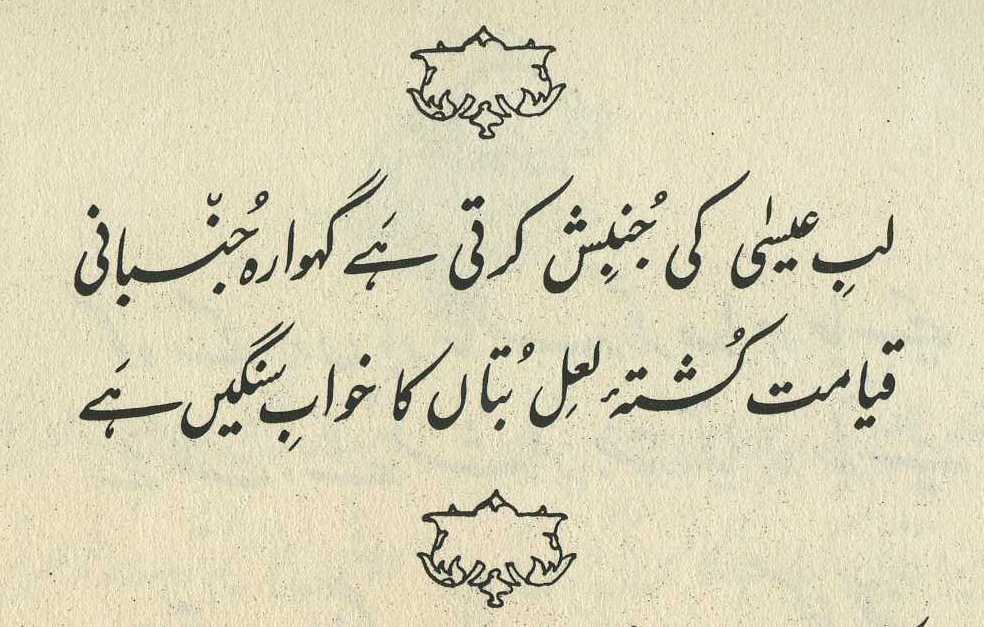
Oh Ghalib, after the desert/wilderness of seeking comes the desert of oblivion. The sweat of the steed of courage sweeps away the 'saddle-chamber'. That is, after this state/condition comes the state/condition of detachment.
== Asi, p. 267
That is, for a whole lifetime one kept galloping the horse of courage in the desert/wilderness of seeking. When the horse grew tired and became covered with sweat, such that it was submerged in it up to the saddle, at that time the halting-place that had been reached was the desert of oblivion.
In the commentary on the last verse of the previous ghazal I wrote that there was need for a correct/proper selection . Just look at how good this present ghazal is, which has been chopped up and thrown away, and he only kept one verse-- which was the weakest verse in the whole ghazal!
== Zamin, p. 390
On the road of the mystical path, after searching comes the stage of oblivion. The horse of courage, after much effort and exertion, traversed the desert of searching. The sign of this effort is his sweat. This itself, having become a torrent, destroyed the 'saddle-chamber' []. The rider remains in the 'saddle-room', as if the intensity of ardor brought him to the stage of oblivion. They call the curve of the saddle the 'saddle-chamber'.
== Gyan Chand, p. 390
For background see S. R. Faruqi's choices . For more on Ghalib's unpublished verses, see the discussion in 4,8x .
A noun compound like 'sweat-steed' is rare in Urdu, but common in Persian; for discussion, see 129,6x . A steed consisting of, or identified with, sweat-- let's face it, that's a pretty distracting and unappetizing image. Since its grossness gets in the way of poetic effectiveness, it fits my (subjective, exploratory) category of 'grotesquerie'.
Or if we want to read the construction as a case of 'loss of the izafat' [] (on this see 81,8x ), then it would become 'the sweat (of the) steed of courage'. This is how the commentators read it, and it's not quite as grotesque (though the image of a flood of horse-sweat isn't really all that attractive either).
One of the metaphors for achieving a state of mystical beyondness and self-lessness is that of having one's (preferably desert-located) 'house' swept away in a 'torrent' or 'flood'; for a classic example, see 15,10 . The permutation imagined in the present verse seems to be that the mystical seeker, after exhausting and overheating himself while traversing the desert/wilderness of 'searching', is finally swept out of the saddle by a 'torrent, flood'-- not of insight or Divine love, but of his own and/or his horse's sweat. (Such a notion is perfectly in accord with Ghalib's penchant for insisting on 'indepencence' at all costs.)
But basically, this is a verse of wordplay. The cleverly exploited term 'chamber of the saddle' [] is perfectly placed to unite the two images of the horse and the (flooded-out) house; and in classic mushairah -verse style, it's positioned at the last possible moment, in 'punch-word' position, at the end of the second line. Without it, how could the verse fail to fall apart? Let's be grateful to Gyan Chand for thinking to mention that 'they call the curve of the saddle the 'saddle-chamber'.'
graphics/steed.jpg