Verse 31855aarkii
G3
1
we are not eager/'hungry' for a stroll in the garden, but
2
how/why would one/we not take/'eat' it-- for there/it is the air/desire of spring
'Moving about, strolling, stroll, ramble, walk, taking the air, airing, perambulation, excursion, tour, travels; recreation, amusement; scene, view, spectacle, landscape; perusal (of a book, &c.); a sally (of wit, &c.), a jest'.
'Air, atmosphere, ether, the space between heaven and earth; --air, wind, gentle gale; --a gas; --flight; --an aerial being; spirit, fiend; --sound, tone; --rumour, report; --credit, good name; --affection, favour, love, mind, desire, passionate fondness; lust, carnal desire, concupiscence; --an empty or worthless thing'.
'To breathe the air; to take an airing; --to walk about idly, to lounge or saunter about; --to walk away, go away, be off'.
| References | |
|---|---|
| Arshi, Imtiyaz Ali | Ghazal# 233 |
| Raza, Kalidas Gupta | 460 |
| Hamid Ali Khan | Open Image |
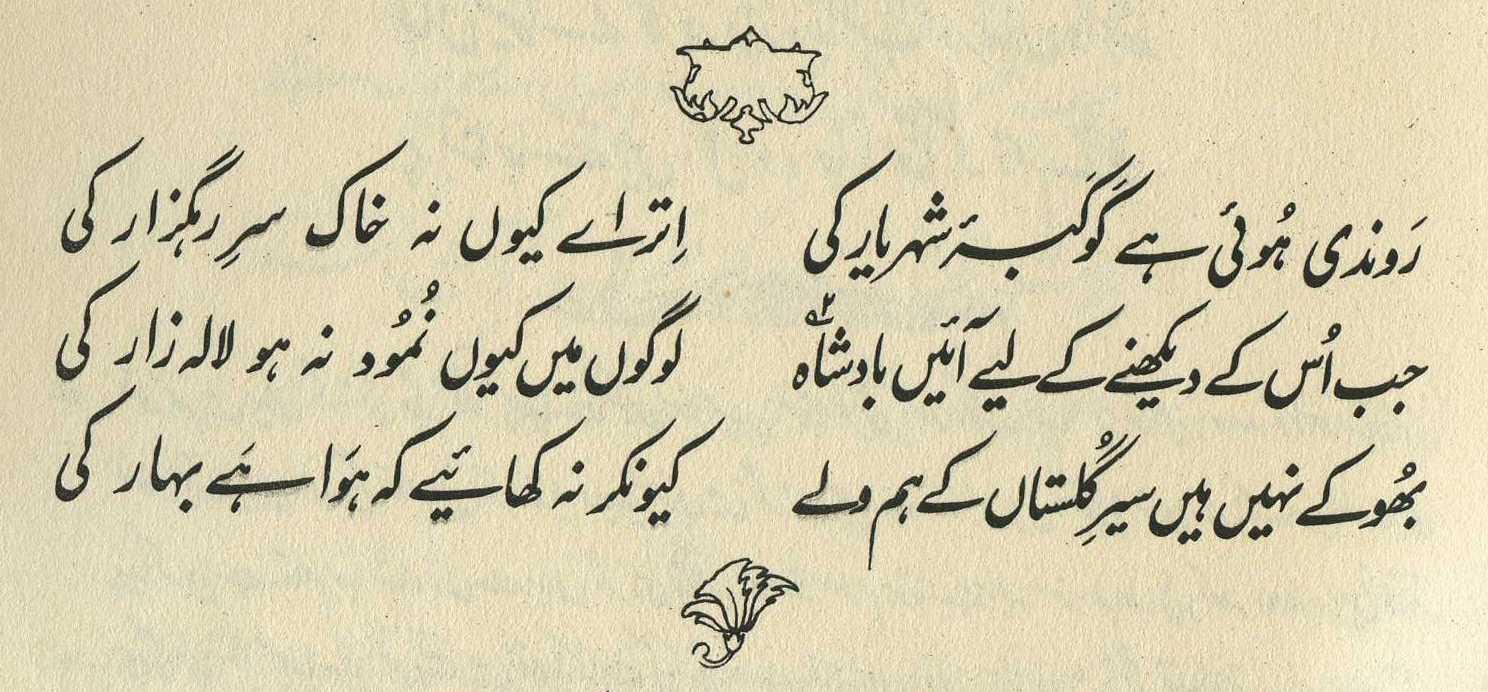
The conclusion of this verse that emerges, is that the relish for the pleasure of the world is not good, but neither ought one to refuse a grace given by the Lord. (249)
== Nazm page 249

He says, 'We aren't particularly eager for a stroll in the garden; that is, we don't have a desire for the relish of the world. But the spring season too is a grace that has been bestowed by God the Most High; for this reason, one ought certainly to take a stroll in it.' (307)
We don't have a longing for a stroll in the garden, but when we became attentive to the air of spring, then naturally we were compelled. That is, the attraction of rose and jasmine does not draw us toward them; rather, we are a lover of the spring breeze.
[Or:] We haven't given our heart to the pleasures of the world. But to reject them is 'denial of grace'. Thus we accept them. (449)
We are not hungry for a stroll in the garden, but in the spring breeze there is such attraction that it spontaneously draws our heart toward itself. Thus why would we not obtain joy from it? (521)
means 'eager'; for just this wordplay he has brought in , which means 'to enjoy'. Although we are not eager for the relish of the world, aversion to the Divine grace is not good either. Moreover, the scene of spring, and the excellence of the sight of it, willy-nilly attracts me toward it. (486)
means 'but'. With , too is very enjoyable. The point of the verse is that although the world's beauty is transitory and is not worthy of having the heart set upon it, still since it is the Lord's blessing, one ought to respect it; he who pushes it away is a 'denier of grace'. (349)
We have no special longing for a stroll in the garden. The spring breeze is so heart-attracting that willy-nilly, the temperament wants to obtain pleasure from it. Basic image: praise of the spring breeze. (811)
We are not hungry for a stroll in the garden, but there's the spring breeze, about the pleasingness of which there's no scope for argument; so why wouldn't we take/'eat' it? (694)
This is one of the verses where I just have to say 'pooh!' to the commentators. Why would anybody ever exclaim over a sententious, prosy, commonplace religious reflection? (And if nobody would exclaim that, why would anybody bother to compose the verse?) In this case, moreover, the commentators' religious reading doesn't just narrow the meaning of the verse (to one choice out of many), but actually invents it. You, dear reader, be the judge: is there one single word in the verse that suggests a religious obligation to enjoy the springtime? Is there one single word about moral obligation, to justify the that so many commentators use or suggest? They are apparently taking to imply 'ought'-ness, but its perfectly clear meaning is 'how/why would one not eat it?'-- a phrase that could just as easily be used to explain an addiction to ice cream. And the few commentators who don't emphasize the religious-duty reading offer an equally bland and simplistic reading: 'the spring breeze is pleasant, so it makes me want to walk in the garden'.
In fact, the verse hinges on two kinds of wordplay. The first is the obvious one, noted (to their credit) by Shadan and Josh, between , 'eager' or (literally) 'hungry', and , to 'take the air' or literally to 'eat the air'.
The second and more clever wordplay centers on the multiple possibilities of . Beyond its role in creating the idiomatic phrase , it has many other possibilities (see the definition above) that can't help but spring (sorry, sorry!) to mind. By no coincidence, the grammar frames the word as unrestrictively as possible: 'the of spring is'. Why in fact is the speaker drawn to stroll in the garden, although he isn't particularly eager to do so? Here are some possible reasons:
=The general 'air' or 'atmosphere' of spring calls to him.
=The spring 'breeze' is blowing.
=There's a 'rumor' that spring is coming.
=The 'credit, good name' of spring needs to be upheld.
=The 'affection' for spring itself is in his heart.
=The romantic 'desire' generated by spring makes him think of the garden.
=The great charm of spring, although it's trivial or 'empty' or 'worthless', overpowers him against his will.
Moreover, in terms of English structure, the Urdu clause pattern 'X is' can be read either generally as 'there is X' or 'X exists' (as in the above examples) or specifically as 'it is X'. If we read 'it is the of spring', then what is the 'it'? Here are some possibilities:
=the spring breeze, as an 'it' which is to be 'eaten'
=the garden itself
=the thought of a stroll in the garden
=actually taking a stroll in the garden
=the force that overcomes the speaker's lack of interest
Isn't it remarkable how such simple means can produce such extravagant, overlapping, ebbing and flowing, mix-and-match effects-- with every single one of them spring-like? And as I write this, it is a heavenly day in May.
graphics/springflower.jpg