Verse 31816aa))iihai
G18
1
to such an extent grief teaches the styles/degrees of restraint/regulation
2
whatever wound would come into view, is a single/particular/unique/excellent reproof/'eye-showing'
'Measure, measurement; quantity; weighing, weight; degree, amount; valuing, valuation, value; rough estimate; conjecture, guess; proportion, symmetry; elegance, grace; mode, manner, style, fashion, pattern; carriage, bearing, gait; modulation (of the voice); time (in music)'.
'To reprove'.
| References | |
|---|---|
| Arshi, Imtiyaz Ali | Ghazal# 152 |
| Raza, Kalidas Gupta | 244-245 |
| Nuskhah-e-Hamidiyah | 220-221 |
| Asi, Abdul Bari | 230 |
| Gyan Chand | 353-354 |
| Hamid Ali Khan | Open Image |
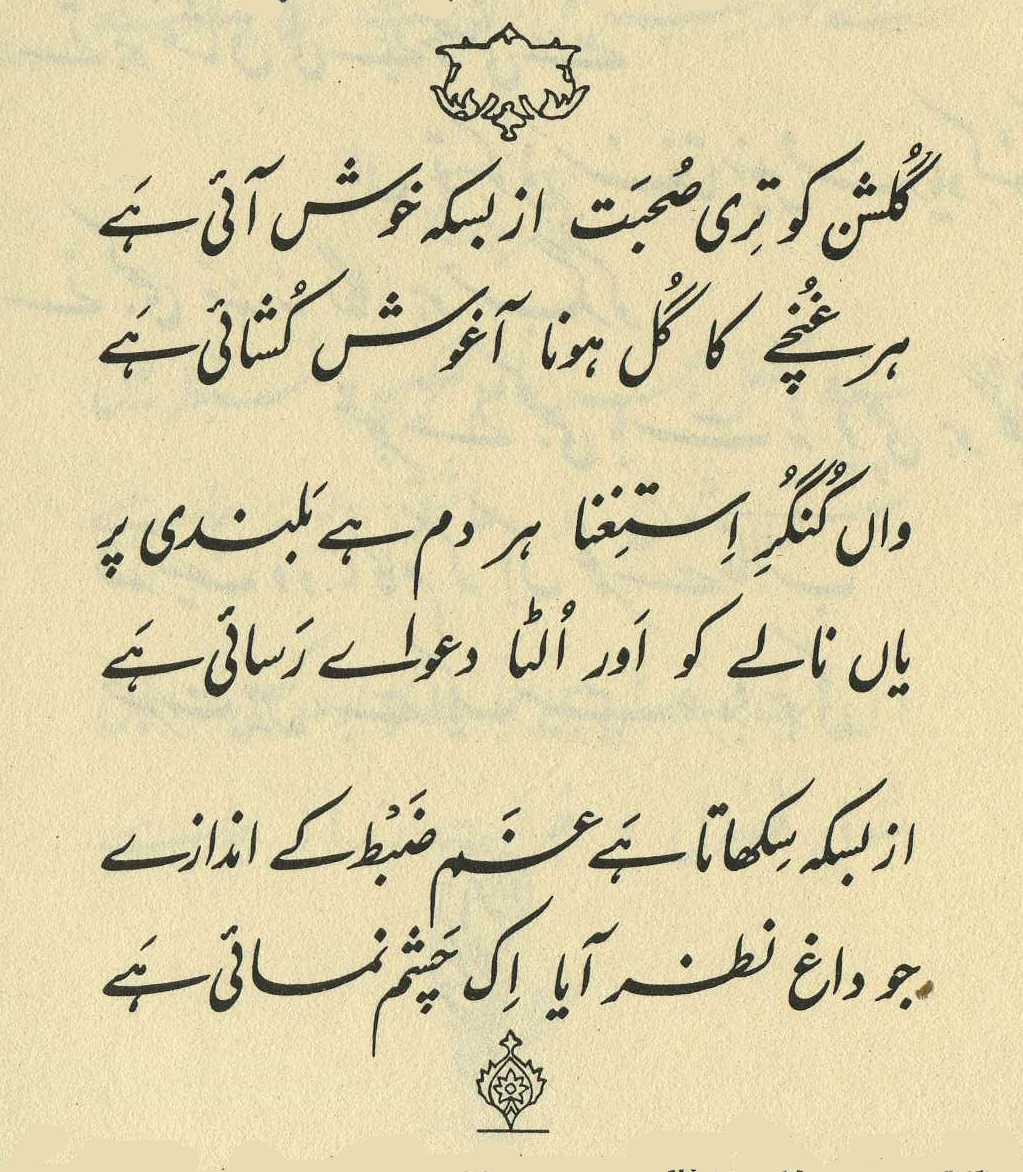
Grief is teaching the lesson of restraint-- whatever new wound appears is the 'eye-showing' of that Ustad . The cause for a wound's similitude with an eye is obvious. (207)
== Nazm page 207

He says, 'The grief of passion is giving me education in restraint. Whatever new wound arises in the heart. it serves as the 'eye-showing' of that Ustad-- that is, the grief of passion.' (267)
= To show an eye []; to browbeat/threaten [].... Whatever wound is created in the heart, one ought not to consider it a wound; rather, it does 'eye-showing', that 'be warned, don't renounce restraint!'. It's not strange that this would be a new theme . (365)
A wound (especially a deep dagger-slash) is like an eye (especially a narrowed one) because they're both outwardly somewhat linear-appearing, and they both conceal their major depths behind a deceptively small surface opening.
Moreover, there's the idiomatic meaning for of 'browbeat' or 'threaten'; on this point Bekhud Mohani is supported by Chishti, who adds 'to scold' [] (738); and Mihr, who also proposes the ideally relevant 'to look angrily at' [] (606). Also enjoyable is the word- and meaning-play between the 'eye-showing' and the 'coming into view' [] of the wound. In fact the main appeal of the verse is the clever deployment of this idiom.
Each wound that becomes visible is thus a reproving 'eye-showing' by Grief, reminding the lover that wounds shouldn't come into view at all, but instead should remain hidden. Or else we can read the first line not as a personification of an active Grief, but as a more general reflection. In that case it's the lover himself, having learned from his grief the lessons and 'styles' or 'degrees' of restraint, who admonishes and polices his own behavior in the second line.
Note for grammar fans: We can read the perfect as a substitute for the future subjunctive ; on this idiomatic usage see 35,9 .
graphics/woundeye.jpg