Verse 11833
G5
In this meter the first long syllable may be replaced by a short; and the next-to-last long syllable may be replaced by two shorts.
1
what was even there in the house, that grief over you would have laid waste to it?!
2
what we used to maintain/keep-- a single/particular/unique/excellent longing for/of construction-- well, that exists/'is'
'Grief, regret, intense grief or sorrow; —longing, desire'.
'Building, constructing; construction, structure; rebuilding; repairing'.
'pron. He, she, it; that, that one, that person or thing; — adv. & conj. So, so that, therefore, hence, consequently, accordingly; but then; thereupon; now, well'.
| References | |
|---|---|
| Arshi, Imtiyaz Ali | Ghazal# 202 |
| Raza, Kalidas Gupta | 382 |
| Hamid Ali Khan | Open Image |
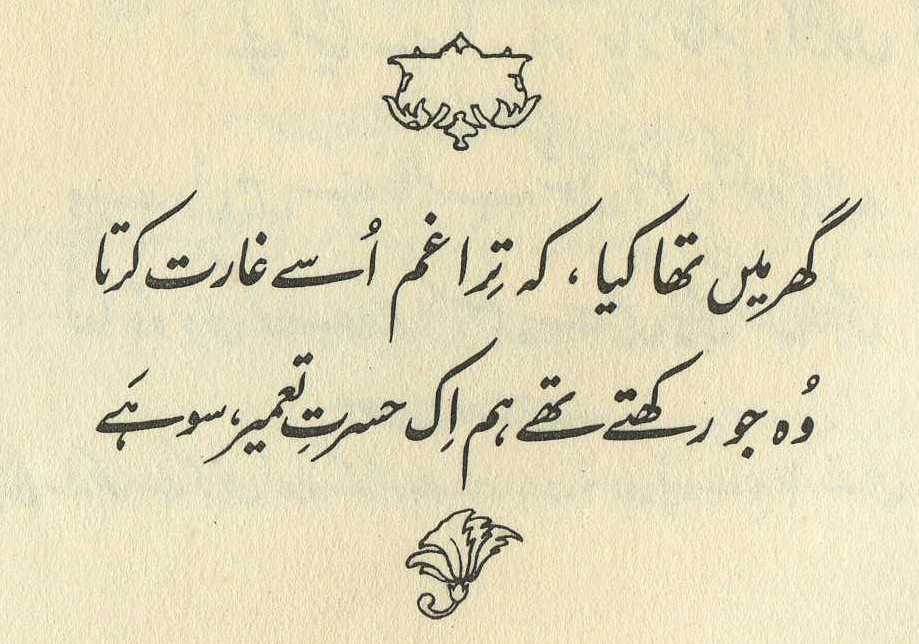
[1859, to Mihr:] The state of Delhi is this: {135,1}. What's even here, that anybody would loot it? That information [about looting] is only a false rumor. (Arshi 306)
==Urdu text: Khaliq Anjum vol. 2, p. 721
==another trans: Russell and Islam , p. 204
==another trans: Daud Rahbar , p. 100
Not even the grief of passion destroyed that longing. (145)
== Nazm page 145

Ghalib says: 114,6 . (345)
He says, although the grief of passion destroyed us, not even it could destroy the longing for construction. And this very longing for construction was the greatest wealth of our house. Besides it, there was nothing else in our hut that the grief of passion would have destroyed. (201)
We were in such a ruined condition that in our house there was nothing at all, that the grief of passion would have looted it. Indeed, in the heart there was the longing for construction and flourishingness []; that is still here today. That is, even previously we had the longing that we would be worthy of something, and that passion would loot us and make us happy. And even today that longing remains. (267)
The verse is easy, colloquial, almost offhand. After the conflagration, the homeowner is being asked what he has lost in the blaze that consumed his house. He shrugs his shoulders and says, 'What did I even have in there to lose? What I had was just one thing, and that'-- perhaps he pauses for a moment to glance over at it and check, or perhaps he doesn't even need to check-- 'well, that's still here'. It's the way one might talk about a fireproof safe. But what is it?
In proper mushairah performance style, the punch-phrase, the identity of the one surviving thing, is withheld until almost the end of the second line. (Since this verse is an ' individual ' even in its original form, it's impossible to tell for sure what its rhyme and refrain would have been-- perhaps , perhaps merely .) In any case, this one surviving thing is so arresting, so bizarre and fascinating, that all by itself it suffices to energize the verse. The one survivor of the complete conflagration is single []-- and/or 'particular', 'unique', 'excellent'. It is a 'longing/sorrow for/of construction' [].
Thanks to the beautifully exploited multivalence of the , the possible readings of this arresting phrase include:
=a longing for building, for construction in general
=a longing specifically for rebuilding, reconstruction (of a particular destroyed thing)
=a sorrow that is generated by building or constructing something
=a sorrow that is itself identical with building or constructing something
=a regret over having built or constructed something
Why has this one extraordinary, protean thing survived? Because it's so abstract that it's indestructible? Because it's of so little consequence that it was hardly there to begin with (as the first line rhetorically suggests)? Because a longing for (re)construction would be exactly the thing that would emerge more intensely after devastation and ruin? Because the devastation caused by the grief of passion might, to the lover, be the force that razes an old building in order to make possible a new one?
Ghalib especially enjoys the multivalence of ; the word seems always to appear in contexts of the most extreme abstraction. The great classical example is 10,6 ; but especially apropos here is 114,6 , since it too features a .
The simplicity of the verse, the colloquial tone-- and then suddenly, yet casually and dismissively tossed in, that wildly abstract and indestructible 'possession' (something that the speaker used to 'keep' or 'maintain', and confidently continues to harbor), the 'longing/sorrow for/of construction'. Is it a 'hope-springs-eternal' verse, or a wry expression of despair? As so often in the case of Ghalib, it seems to be both at once.
Compare Mir's own brilliant take on the devastation of the lover's house/city/heart: M 740,3 .
http://www.flickr.com/photos/samhickman/247540055/ graphics/ruins.jpg