Verse 31833aa;Nko))ii nah ho
G1
1
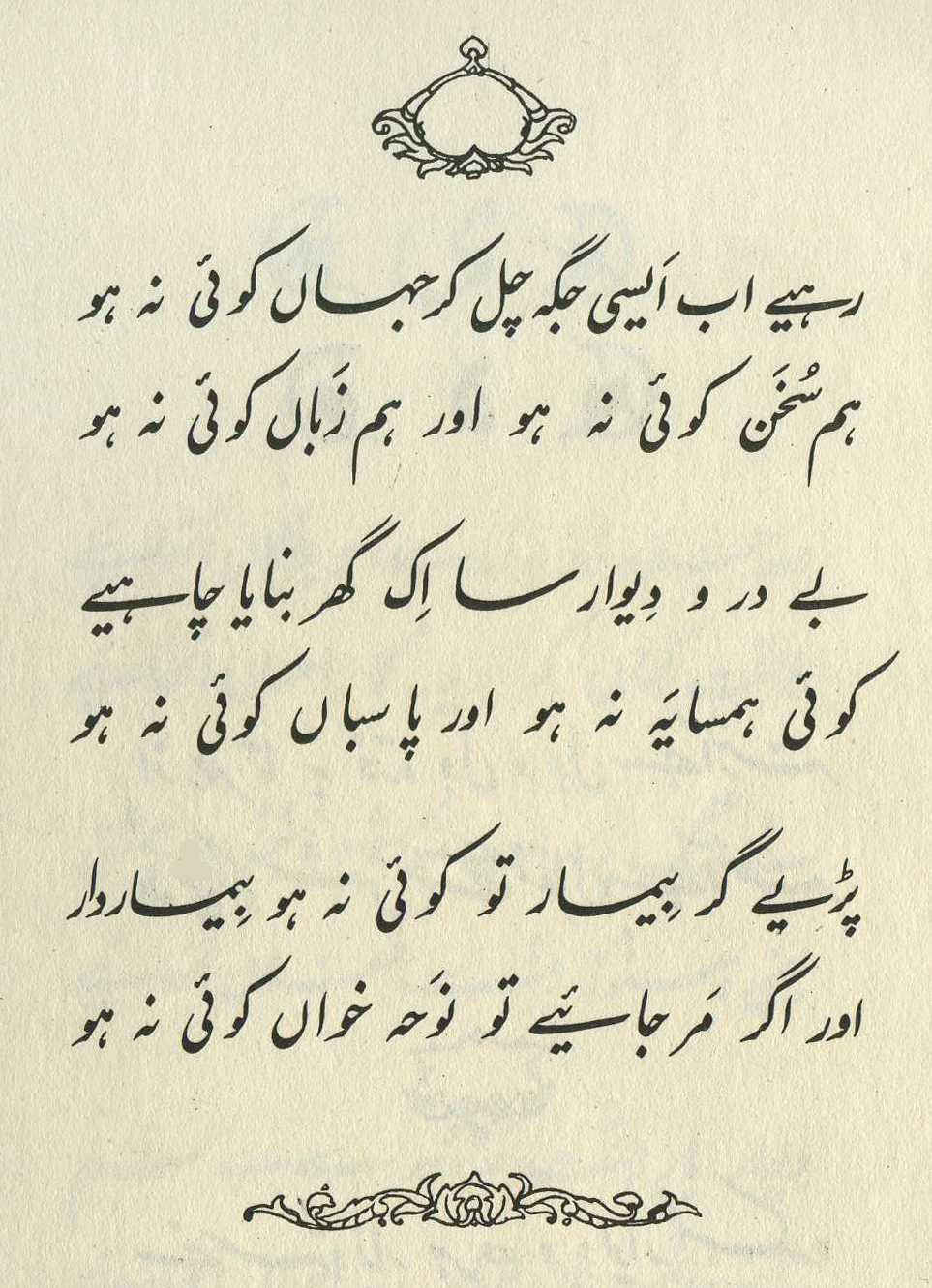
if one would fall sick, then there would be no sick-attendant
2
and if one would die, then there would be no lament-reciter
'Attendant on the sick, sick-nurse'.
'Lamentation; moaning, moan; wail (over the dead)'.
| References | |
|---|---|
| Arshi, Imtiyaz Ali | Ghazal# 121 |
| Raza, Kalidas Gupta | 381-82 |
| Hamid Ali Khan | Open Image |
[1862, to Ala'i:] I envy the situation of island-dwellers in general, and of the lord of Farrukhabad in particular, whom they put off the ship and left on the shore of the land of Arabia. Hah! []: {127,3}. (Arshi 246)
==Urdu text: Khaliq Anjum vol. 1, pp. 387-88
==another trans.: Russell and Islam , p. 271
That is, the people through whom he experienced grief-- from then on, even their nursing and dirge-recitation is not acceptable to him. (138)
== Nazm page 138

He says, in such an alien [] dwelling, suitable for being wished on one's enemies, if you fall sick, then no one from among those enemies who have caused you grief will become a nurse. And if, God forbid, you die, then from among those cruel friends who have caused you difficulties, no one will be a dirge-singer in a mourning assembly. (193)
Where the sick person would lie, then no one would serve him; and if he would die, then no one would weep over his body. (258)
On the apparent unity in this small ghazal, see 127,1 .
Some editors and commentators have instead of , the alternative reading . Steingass gives for 'Sorrow, grief; care, attendance on the sick; sympathy; defence, custody'; for he gives 'A manager of property; caretaker' (343). Platts doesn't give the word at all. But in any case, it doesn't matter what it means, since the best evidence is that it's not what Ghalib wrote. The scholarly work of manuscript collation has been carefully done by Arshi, whom I follow as usual.
This verse offers us two parallel lines with their 'if' clauses in the polite imperative (a refined, courteous substitute for the plural subjunctive) and their 'then' clauses in the plural subjunctive. How seriously are we to take the parallelism? Is falling sick a condition similar (or prepatory) to dying, so that a nurse is simply a precursor of a mourner? Or do these two lines offer two separate examples of the conditions of an ideally solitary life?
The structure of this verse also shows how instinctively and unavoidably we tend to read this verse as part of a verse-set , even though it officially isn't one (on this see 127,1 ). It's hard to believe that Ghalib didn't mean for us to carry over the context of the earlier verses for this one. For after all, if we didn't read this verse in the context of the two previous ones, it might perfectly well be a lament about the evils of solitary living ('How terrible-- if you get sick there'd be no one to nurse you, and if you die there wouldn't even be anyone to mourn you!'). The fact that we tend not to read it that way shows that we're letting it be governed by the two preceding verses. Without the preceding two verses it could even be a lament about, say, poverty and friendlessness in a big city ('Nobody cares whether you live or die!'); for there's nothing in the verse itself about solitary living or fleeing all human company.
As the rounding-off of a little three-verse riff on solitude, however, it's a great success. Not only does it complete the hermit's journey (he goes to a solitary place of some kind, he builds a non-house, he eventually gets sick unattended and dies alone), but it somehow does it with a feeling of proper closure, even of satisfaction. This vision of solitary decline and death doesn't feel half as grim or bleak as it should. Perhaps this is because the speaker so palpably advances it as an ideal end.
graphics/ruins.jpg